1/4 HP vs 1/2 HP Cold Plunge Chiller: The Complete Sizing Guide 2026

In this guide
The 1/4 HP vs 1/2 HP question is the most common sizing debate in the DIY cold plunge community. The answer matters because an undersized chiller means you never reach your target temperature — and because the specifications manufacturers advertise are often the worst guide to actual performance.
This guide is built on three primary sources: Joseph Krause of DIY Cold Plunge (diycoldplunge.com), who has personally tested more cold plunge chiller configurations than any other documented builder; Adam Smith of ReGen Total Wellness, who published the most rigorous head-to-head specification comparison of the two leading units; and Roberts Hot Tubs, who provide commercial-grade sizing tables. All data is cited and sourced throughout.
The short answer
Joseph Krause, DIY Cold Plunge (April 2025), after testing more cold plunge chillers than any documented community builder:
“1/4 HP is what 90% of people need to consider. 1/2 HP if you are in an extreme climate.”
| Question | Evidence-based answer |
|---|---|
| Can a 1/4 HP reach 34°F? | Yes — same minimum temperature as a 1 HP unit. HP affects cooling speed, not final temperature. |
| What does more HP give you? | Faster cool-down. Once at temperature, a larger chiller provides no advantage in maintenance mode. |
| Who needs 1/2 HP? | Extreme climates (90°F+ sustained ambient), direct sunlight exposure, uninsulated tubs, or volumes over 150 gallons. |
| Is HP a reliable buying metric? | No — it is one of the most misleading specs in this market. Focus on BTU/hr and verified test data. |
BTU, HP, watts & amps — what actually matters
BTU/hr — the only metric that directly measures cooling performance
British Thermal Units per hour (BTU/hr) measures how much heat a chiller removes from the water per hour. This is the only specification that directly measures what you are paying for. Adam Smith (ReGen Total Wellness): “BTU/hr gives you the best apples-to-apples comparison of how fast a chiller can actually cool your plunge.”
A practical example: a chiller rated at 8,500 BTU/hr can cool approximately 100 gallons of water by 30°F in 3 hours under ideal conditions. This lets you calculate cool-down time for your specific setup. The key numbers: Active Aqua 1/4 HP = 3,010 BTU/hr. EcoPlus 1/2 HP = 5,115 BTU/hr.
Horsepower — the most misleading metric
HP refers to the motor’s peak mechanical output, not how efficiently that work is converted into heat removal. As ReGen explains: “It is very possible — and common — for a 1/2 HP chiller with an efficient compressor to outperform a 2.0 HP chiller that is poorly designed.”
Many cold plunge brands sell identical aquarium chillers at 2–3× the price with their logo printed on the front. Joe Krause explicitly: “There are countless cold plunge companies that sell these chillers for 2x and 3x the price with horrible customer support when things go wrong.” Do not pay more than $250–$280 for a budget-brand 1/3 HP chiller regardless of what HP number appears in the marketing materials. Ask for BTU/hr and real-world test data before purchasing any chiller over $300.
BTU per watt — the efficiency metric that matters
BTU-per-watt measures how many BTUs of cooling you get for each watt of electricity consumed. This is where the most surprising number in the whole comparison lives: the 1/2 HP EcoPlus is 54% more energy efficient than the 1/4 HP Active Aqua — not because it uses more electricity, but because its compressor design converts that electricity to cooling more effectively.
| Metric | What it measures | What it does NOT tell you |
|---|---|---|
| BTU/hr | Heat removed per hour — direct measure of cooling capacity | Doesn’t account for ambient temperature variability or insulation quality |
| HP (horsepower) | Peak mechanical power of the motor | Cooling efficiency; actual heat removal rate; how efficiently mechanical work becomes cooling |
| Wattage (W) | Total electrical power consumed | Cooling output — a high-watt inefficient chiller may cool less than a lower-watt efficient one |
| Amperage (A) | Current draw — important for circuit compatibility | Performance directly — two same-amp chillers on different voltages have very different performance |
| BTU per watt | Cooling efficiency — BTUs delivered per watt consumed | Time to cool a specific volume — you still need absolute BTU/hr for that |
Active Aqua 1/4 HP vs EcoPlus 1/2 HP — head-to-head
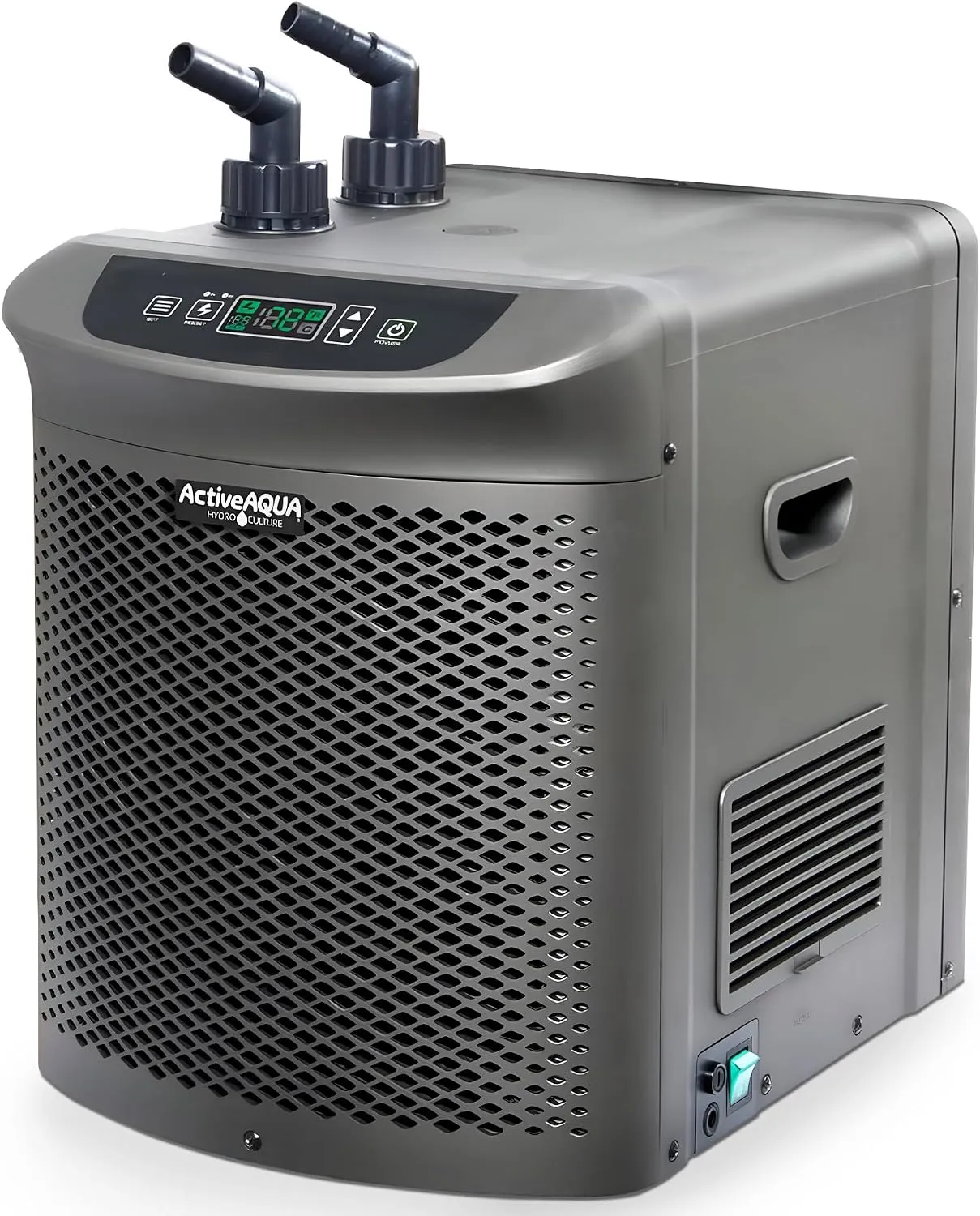
Active Aqua 1/4 HP Hydroponic Water Chiller
3,010 BTU/hr · 460W · 4.7A · Pure titanium evaporator
The most durability-tested cold plunge chiller in the DIY community. Joe Krause has run his unit outdoors in Minnesota for 3+ years through rain, snow, and summer heat. Used as the OEM chiller inside Plunge, Renu, and ModTub systems.
Check price on Amazon →The following specification comparison is from ReGen Total Wellness (Adam Smith), the most rigorous publicly available head-to-head data for these two units:
| Metric | Active Aqua 1/4 HP | EcoPlus 1/2 HP | What it means |
|---|---|---|---|
| Cooling capacity (BTU/hr) | 3,010 BTU/hr | 5,115 BTU/hr | EcoPlus removes ~70% more heat per hour — significantly faster cool-down |
| Power consumption (watts) | 460 W | 510 W | EcoPlus uses only 50W more while delivering 70% more cooling |
| Amperage draw | 4.7 A | 4.4 A | EcoPlus draws less current despite higher HP — compatible with standard 15A circuits |
| BTU per watt (efficiency) | ~6.5 BTU/W | ~10.0 BTU/W | EcoPlus is 54% more energy-efficient per unit of cooling delivered |
| Minimum temperature | 34°F (1.1°C) | 34°F (1.1°C) or lower | Both can reach 34°F; EcoPlus gets there faster |
This is counterintuitive and worth understanding. The EcoPlus uses a more efficient compressor and thermal transfer system that converts electrical input to cooling output more effectively. The result: 10 BTU per watt vs 6.5 BTU per watt for the Active Aqua. You get 54% more cooling per dollar of electricity with the EcoPlus, and it draws less current because efficiency improvements reduce the total electrical work needed. This demonstrates why HP is a misleading buying metric — the Active Aqua has lower rated HP but draws more amps and delivers less cooling.
Real-world durability — Joe Krause’s personal testing log
Joseph Krause has personally tested every major cold plunge chiller in real outdoor conditions in Minnesota — among the most demanding environments in the continental US for outdoor cold plunge maintenance. His log is the most comprehensive real-world durability dataset available outside laboratory conditions:
| Chiller | Result | Duration | Notes |
|---|---|---|---|
| Active Aqua 1/4 HP | Still working — strong | 3rd year (as of April 2025) | Outdoor MN exposure: rain, snow, sun. Minor shell blemishes. Top recommendation. |
| EcoPlus 1/4 HP | Still working — degraded display | Same outdoor conditions | LED display panel no longer fully lit; otherwise functional. Same outdoor abuse as Active Aqua. |
| Active Aqua 1/2 HP | Tested and validated | Ongoing | Same build quality as 1/4 HP; validated for high-demand scenarios. |
| Active Aqua 1/10 HP | Insufficient — not recommended | Indoor test only | Tested in climate-controlled indoor environment — still not enough. Avoid. |
| Penguin 1/2 HP HE | Died after 1.5 years | 1.5 years | “Worked great for 1.5 years and then died.” Does not hold up to outdoor elements. |
| Rocita 1/3 HP (Walmart) | Working — higher defect rate | 1 year (2 indoor units) | Both friends’ units still going after 1 year indoor use. Community reports higher defect rate than Active Aqua. Best budget option if staying under $250. |
| Vevor 1/4 HP | Works — long-term uncertain | Short-term | Works fine short-term. Long-term outdoor durability unconfirmed. Fittings noted as difficult. |
| Generic all-in-one | Failed — 2 units burned through | Short-term | Burned through two units from same company. Do not recommend. |
The durability verdict: Active Aqua has the longest documented outdoor track record in the DIY community — Krause describes it as having “the largest track record in the space” and notes it is used by major cold plunge brands including Plunge, Renu, and ModTub as the OEM chiller inside their premium systems.
Why insulation matters more than HP
The single biggest factor in cold plunge chiller performance — bigger than horsepower, bigger than BTU/hr, bigger than ambient temperature — is tub insulation. An uninsulated tub fights the entire ambient environment. The chiller runs continuously against constant heat gain. Conversely, a well-insulated tub holds temperature with minimal chiller run time.
Joe Krause explicitly: “If you are doing an insulated DIY cold plunge build, a larger chiller can really be a waste of money.” His own 1/4 HP Active Aqua handles Minnesota summers (high 80s–low 90s ambient) in an insulated stock tank build.
Roberts Hot Tubs confirms: “A tub with at least three inches of thick, high-density spray foam insulation outperforms a bare metal or thin plastic tank. Bad insulation causes your chiller to work harder and run longer, raising the cost of your electric bill.”
| Insulation level | Effect on chiller sizing | Electricity impact |
|---|---|---|
| None — bare stock tank, no cover | Chiller runs nearly continuously; 1/4 HP may fail to maintain target in hot weather; 1/2 HP recommended | High — compressor under constant load; reduced lifespan |
| Partial — some spray foam + basic cover | 1/4 HP adequate in moderate climates; 1/2 HP for hot climates | Moderate — chiller cycles on and off; better compressor health |
| Well insulated — 3”+ spray foam all sides + insulated cover | 1/4 HP genuinely adequate for most climates; brief cycles; temperature holds extended periods | Low — chiller may run 30–60 min/day in moderate climates after reaching setpoint |
| Extremely well insulated — chest freezer conversion or purpose-built enclosure | 1/4 HP with very short duty cycles; arguably overkill for initial cool-down | Very low — under $10/month reported for well-insulated 100-gallon builds |
Before buying a larger chiller, invest in better insulation. Upgrading from a bare stock tank to a spray-foam-insulated tank with an insulated cover is worth more to your system’s performance than upgrading from a 1/4 HP to a 1/2 HP chiller. If your 1/4 HP is not keeping up, add insulation first, then re-evaluate whether you actually need more HP.
Cool-down time calculations
Cooling time can be estimated with the specific heat formula: Time (hours) = [Volume (gallons) × 8.34 × Temperature drop (°F)] ÷ BTU/hr
This gives a theoretical minimum. Real-world times run 30–50% longer due to ambient heat gain through the tub walls. A well-insulated tub approaches the theoretical minimum.
| Scenario | 1/4 HP (3,010 BTU/hr) | 1/2 HP (5,115 BTU/hr) |
|---|---|---|
| 80 gal, 70°F → 50°F (20°F drop) | 3.7 hrs theoretical | 2.2 hrs theoretical |
| 100 gal, 70°F → 50°F (20°F drop) | 4.6 hrs theoretical | 2.7 hrs theoretical |
| 100 gal, 70°F → 40°F (30°F drop) | 6.9 hrs theoretical | 4.1 hrs theoretical |
| 150 gal, 75°F → 50°F (25°F drop) | 8.7 hrs theoretical | 5.1 hrs theoretical |
| Maintain temperature during use (body heat ~800 BTU/hr) | Minimal for either — chiller cycles on briefly; both handle body heat load easily | |
Practical implication: For once-daily cold plunge use, a 1/4 HP pre-chilling overnight is completely workable on 80–100 gallon insulated setups. For gyms, multiple daily sessions, or fast on-demand cooling, the 1/2 HP’s faster cool-down time is a real operational advantage.
Decision matrix — which to buy
Note: Active Aqua and EcoPlus prices have risen substantially since the original April 2025 research. Check current Amazon pricing before purchasing. Vevor alternatives are linked throughout.
| Your situation | Recommendation | Reasoning |
|---|---|---|
| Indoor insulated build, moderate climate (below 85°F peak) | 1/4 HP — Active Aqua | Best reliability; adequate for this scenario; proven outdoor track record |
| Outdoor insulated stock tank, moderate climate (below 85°F peak) | 1/4 HP — Active Aqua | Joe Krause runs this exact setup in MN summers (high 80s–low 90s); documented to handle it with good insulation |
| Outdoor insulated stock tank, extreme climate (90°F+ sustained) | 1/2 HP — Active Aqua or EcoPlus | Marginally adequate with 1/4 HP; 1/2 HP provides comfortable headroom and faster recovery |
| Direct sunlight exposure, any climate | 1/2 HP | Direct sun is the most demanding load condition; 1/4 HP may struggle to maintain temperature in midday sun |
| Uninsulated or poorly insulated tub | 1/2 HP — AND add insulation | Insulation makes a bigger difference than HP; if you cannot insulate, get 1/2 HP |
| Volume over 150 gallons | 1/2 HP or larger | Volume drives cool-down time; 1/4 HP on 150+ gallons means very long cool-down periods |
| Tight budget, indoor build, comfortable with Walmart returns | Rocita 1/3 HP — max $250 | Budget option with acceptable indoor reliability; Walmart returns are the backstop; do not pay more than $250 |
| Best cooling performance, budget is secondary | EcoPlus 1/2 HP | Highest BTU/hr; best BTU-per-watt efficiency; lower amps than the 1/4 HP Active Aqua |
| 1/4 HP not keeping up with your current setup | Add insulation first | Insulation is the highest-leverage change; do not reflexively upgrade HP before eliminating insulation as the root cause |
Cost analysis — July 2026 pricing
The BTU, amperage, and durability data in this guide is sourced from April 2025 research and remains accurate. However, Amazon prices for Active Aqua and EcoPlus have risen substantially since that research was conducted. The EcoPlus 1/2 HP is also frequently out of stock as of mid-2026. Always check current pricing before purchasing — links below go to live Amazon listings.
| Chiller | BTU/hr | Power draw | Current price | Availability | Link |
|---|---|---|---|---|---|
| Active Aqua 1/4 HP | 3,010 | 460 W / 4.7 A | Check Amazon | In stock | View → |
| EcoPlus 1/2 HP | 5,115 | 510 W / 4.4 A | Check Amazon | Frequently out of stock | Search → |
| Vevor 110 Gal, 1/3 HP ✦ | Est. comparable | Similar range | $389.90 (direct) | In stock | View → |
| Vevor 500 Gal, 1-1/2 HP ✦ | Higher capacity | Higher draw | $905.90 (direct) | In stock | View → |
✦ Vevor pricing via our CJ affiliate link at vevor.com. Active Aqua and EcoPlus link to Amazon with our Associates tag (chilldive-20).
2026 value verdict: The BTU and durability data in this guide still favours Active Aqua for reliability and EcoPlus for raw performance. However, the pricing landscape has shifted. Active Aqua and EcoPlus Amazon prices have increased significantly — always check current pricing before purchasing. At current price points, Vevor’s direct pricing ($389.90 for the 110-gallon model) represents strong value and the units are consistently in stock. For serious outdoor cold plunge builders who prioritise the documented long-term durability track record, Active Aqua remains the established benchmark. For builders prioritising price and availability, Vevor is now the more competitive option on both counts.
Vevor as an alternative
If Active Aqua and EcoPlus are not readily available in your region, Vevor’s compact aquarium-series chillers are a direct alternative worth considering. They are available through Vevor.com (where we have an affiliate relationship) and Amazon. Joe Krause notes Vevor “works fine” short-term but flags long-term outdoor durability as unconfirmed and the fittings as “difficult to configure.”
For aquarium, hydroponic, and indoor cold plunge use, Vevor’s units are well-regarded and our full Vevor review and Vevor cold plunge guide cover them in detail. For outdoor cold plunge in a demanding climate, the Active Aqua’s documented 3-year outdoor track record is a meaningful advantage.
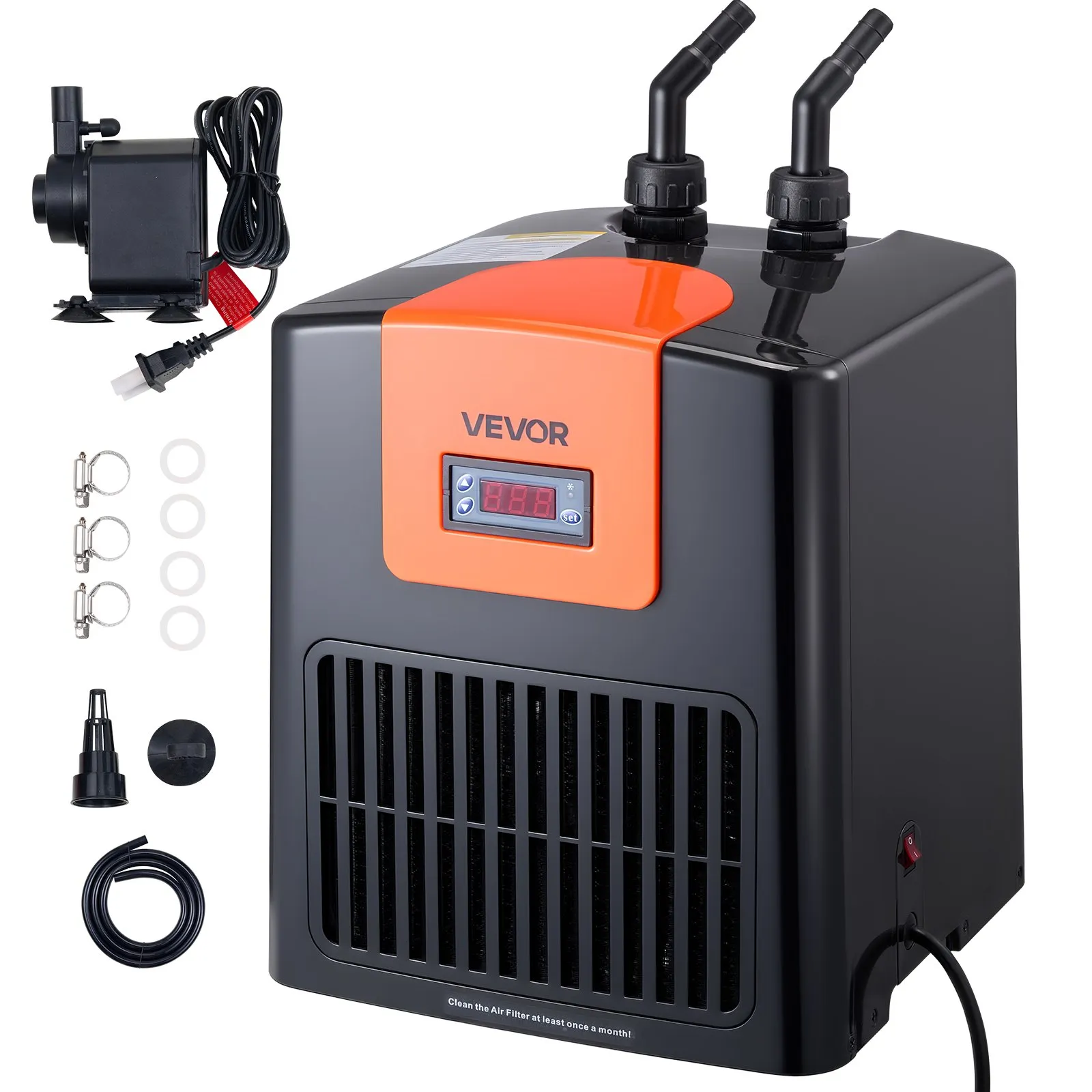
For small builds under 52 gallons. Indoor cold plunge, aquarium, DWC.
View on Vevor →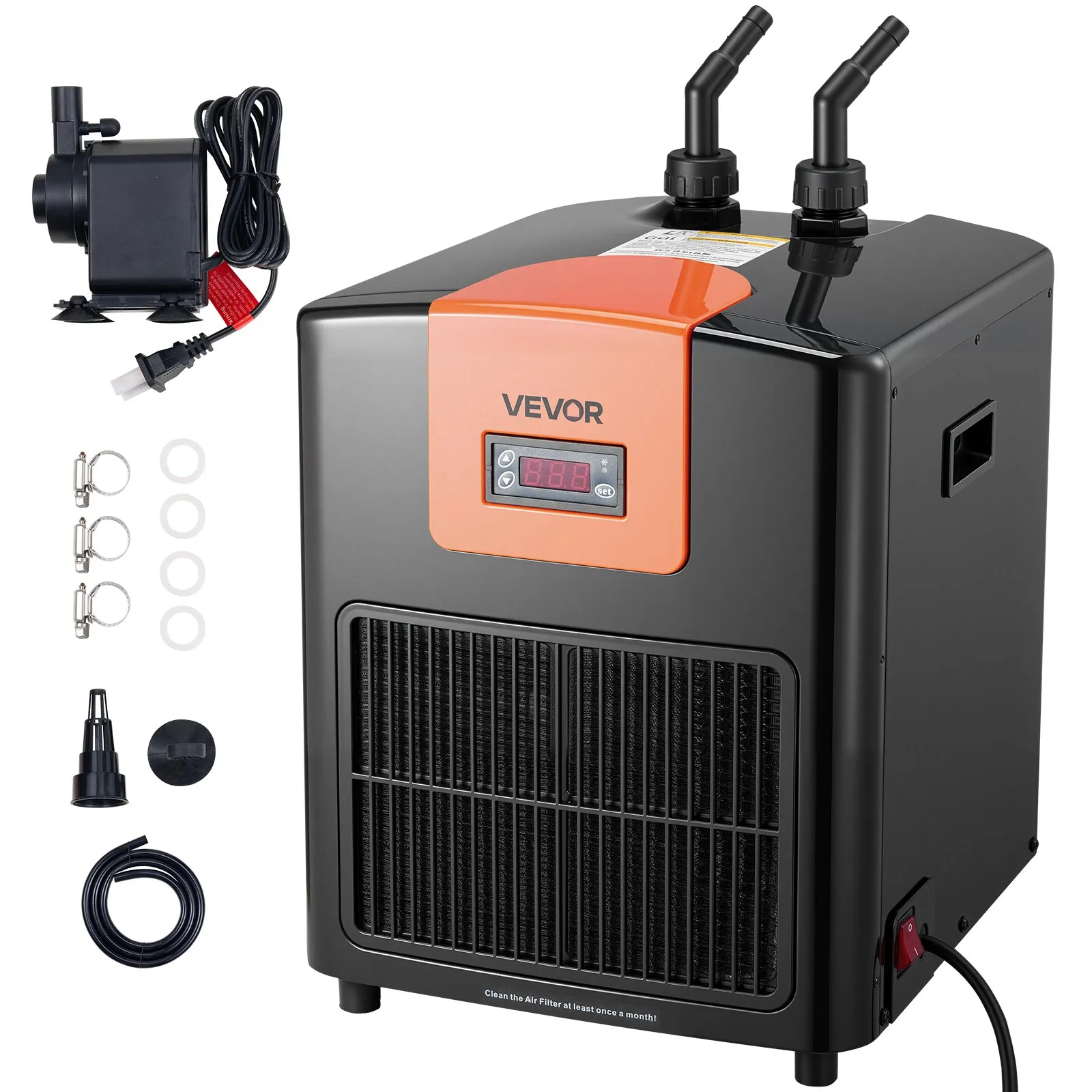
The most popular Vevor model. Covers 60–110 gallon setups indoors and in moderate climates. Full review: Vevor CL-850 review →
View on Vevor →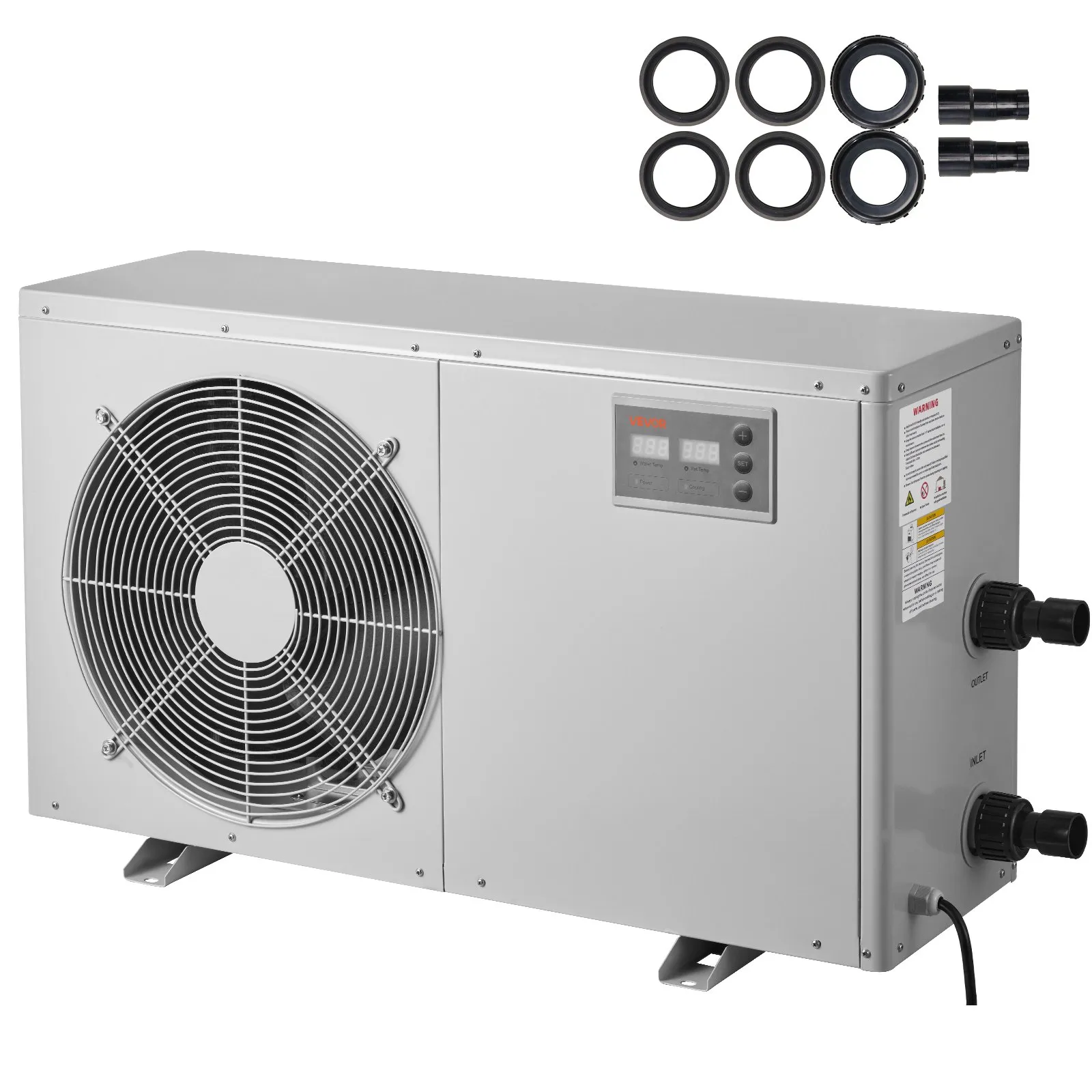
For large DIY builds 100–200 gallons, outdoor setups, and hot climates. R32 variant confirmed at 48°F on 150 gal in 90°F Florida heat.
View on Vevor →Building a complete DIY cold plunge from scratch? See our complete DIY cold plunge build guide covering containers, insulation, plumbing, and three full bills of materials.
Considering Plunge Chill specifically? See our Plunge Chill 1/3 HP review and 1HP review.
FAQs
Is 1/4 HP enough for a cold plunge?
For most DIY cold plunge builds — insulated stock tank, garage or shaded outdoor location, moderate climate below 85°F — yes. Joe Krause, who has tested more cold plunge chillers than any documented community builder, recommends 1/4 HP for 90% of builders. The key requirement is insulation: a well-insulated tub makes 1/4 HP genuinely adequate in most US climates including Minnesota summers.
What is the difference between 1/4 HP and 1/2 HP in practice?
Speed, not final temperature. Both can reach 34°F. The 1/2 HP (EcoPlus: 5,115 BTU/hr) cools approximately 40–50% faster than the 1/4 HP (Active Aqua: 3,010 BTU/hr) and maintains temperature more confidently in hot ambient conditions. Once at temperature, a larger chiller provides no advantage during maintenance mode.
Which is better: Active Aqua 1/4 HP or EcoPlus 1/2 HP?
For most builders: Active Aqua 1/4 HP — best documented outdoor durability (3+ years in MN outdoor conditions), adequate performance for insulated builds in moderate climates, and the community track record. For extreme climates, large volumes, or fast cool-down requirements: EcoPlus 1/2 HP — 70% more BTU/hr, 54% more energy efficient, and draws less current despite higher HP rating.
What BTU/hr do I need for a cold plunge?
Calculate: gallons × 8.34 × temperature drop ÷ hours available for cool-down = BTU/hr needed. Example: 100 gallons, 70°F to 50°F, willing to pre-chill overnight (8 hours): 100 × 8.34 × 20 ÷ 8 = 2,085 BTU/hr needed — the Active Aqua 1/4 HP at 3,010 BTU/hr handles this with headroom.
Why is HP a misleading metric for cold plunge chillers?
HP measures the motor’s peak mechanical output, not cooling efficiency. The EcoPlus 1/2 HP draws fewer amps than the Active Aqua 1/4 HP while delivering 70% more BTU/hr — purely because of better compressor design. Many cold plunge brands inflate HP numbers on marketing materials. The only metrics that matter are BTU/hr (cooling capacity) and verified real-world test data.
How much does it cost to run a cold plunge chiller per month?
At average US electricity rates ($0.15/kWh) running 8 hours per day: Active Aqua 1/4 HP (460W) costs approximately $16–$18/month. EcoPlus 1/2 HP (510W) costs approximately $18–$22/month. In a well-insulated build, the chiller runs significantly less than 8 hours per day once at temperature, reducing actual costs substantially. Multiple verified builders report under $10/month electricity increases for insulated 100-gallon cold plunge setups.
Can I use a Vevor chiller instead of Active Aqua or EcoPlus?
Yes — Vevor’s compact aquarium-series chillers work well for cold plunge, particularly for indoor and sheltered setups. Joe Krause notes Vevor “works fine” but flags long-term outdoor durability as less established than Active Aqua. For our full analysis see the Vevor cold plunge guide and the general sizing guide.