Plunge Chill Cold Plunge Chiller Review 2026: The Honest $499 Assessment
In this review
- Quick verdict
- Who this is and isn’t for
- Full specifications
- Cooling performance — what the numbers actually mean
- The sanitation gap
- Tub compatibility — the genuine strength
- The pricing, read carefully
- What owners report (Trustpilot 4.7)
- Plunge Chill vs the alternatives
- 3-year cost of ownership
- First 30 days — the test protocol
- FAQs
The Plunge Chill cold plunge chiller sits at a price point — $449–$499 — where nothing else with a real compressor refrigeration circuit exists. That gap is real and it matters. The questions worth answering are what you give up to get there, and whether what you give up matters for your specific setup.
This review is built on the manufacturer’s product page and FAQ, Trustpilot owner reviews, independent sizing guidance, and peer-reviewed cold water immersion literature. Every figure that comes from the manufacturer is labelled as such. This is not a roundup with affiliate links and star ratings — it is an honest assessment of a product with a specific buyer profile that it serves well and several scenarios where it does not.
Quick verdict
One-sentence version
Buy it if you plunge indoors or in a mild climate and accept that you will be managing water manually rather than relying on ozone or UV. Do not buy it expecting the advertised $1,099 to represent a real saving — the entire site runs permanent 50% pricing.
| Pick | Situation |
|---|---|
| ✅ Buy it | You currently haul ice; you plunge indoors or in a temperate climate; you use a bathtub or standard inflatable with no ports; you want the lowest-cost refrigerated option and accept manual water management |
| ❌ Look elsewhere | Hot climate (90°F+ garage); more than one daily user; water hygiene is a priority; you want a stated safety certification; you need sub-45°F temperatures reliably in summer |
| ⚠️ Consider both | You are new to cold plunging and haven’t tested whether the habit sticks — try ice for two weeks first before spending anything |
Who this is and isn’t for
The bathtub plunger — best served by this product
The Plunge Chill ships with two circulation options: a built-in pump for tubs with inlet/outlet ports, and a separate submersible pump for tubs that have no ports — including ordinary bathroom bathtubs, standard stock tanks, and inflatable tubs. At this price point with this flexibility, nothing else comes close. If you want to plunge in your existing bathtub without drilling holes or buying a dedicated vessel, this is the most practical option on the market.
The ice-hauler — clear case for any chiller
If you are already plunging with bags of ice at $10–$30 per session, any chiller pays for itself quickly. The Plunge Chill is the cheapest way to end that recurring cost. At four sessions a week, it pays back its $499 in 4–12 weeks depending on local ice prices.
Who should look elsewhere
- Hot climate owners: Independent sizing guidance places 3/4–1 HP as the minimum for sustained 90°F+ ambient, and a competing manufacturer rates its own 1/3 HP unit for climates only up to 85°F. The Plunge Chill’s FAQ states it operates up to 95°F — that describes operation, not holding 39°F at that temperature. Those are different claims.
- Multi-user setups: Without ozone or UV sanitation, water management is manual. Multiple daily users significantly shortens the interval between water changes.
- Anyone wanting ozone or UV: The Plunge Chill has a mesh filter only. The next $400 in this market buys 20-micron filtration plus UV sanitation and eliminates the regular drain-and-refill cycle. See the sanitation section below.
- The curious beginner who hasn’t tested the habit: Try ice for two weeks first. A $200 stock tank and bags of ice tells you whether you will actually keep this practice. If you are still doing it after a fortnight, buy the chiller.
Full specifications
| Specification | Value | Source |
|---|---|---|
| HP rating | 1/3 HP | Manufacturer |
| Power draw | 600 W | Manufacturer |
| Minimum temperature | 39°F (4°C) | Manufacturer — achievable in favourable conditions |
| Best-performance tub size | Up to 120 gallons | Manufacturer |
| Pull-down time (manufacturer) | 75°F → 50°F in 8–10 hrs on ~66 gal; 75°F → 45°F in 12–14 hrs on ~66 gal | Manufacturer |
| Noise level | 39–45 dB | Manufacturer (measurement distance not stated) |
| Weight | 35 lb unit; 46.7 lb shipping | Manufacturer |
| Dimensions | 14.9” × 11.8” × 12.6” | Manufacturer |
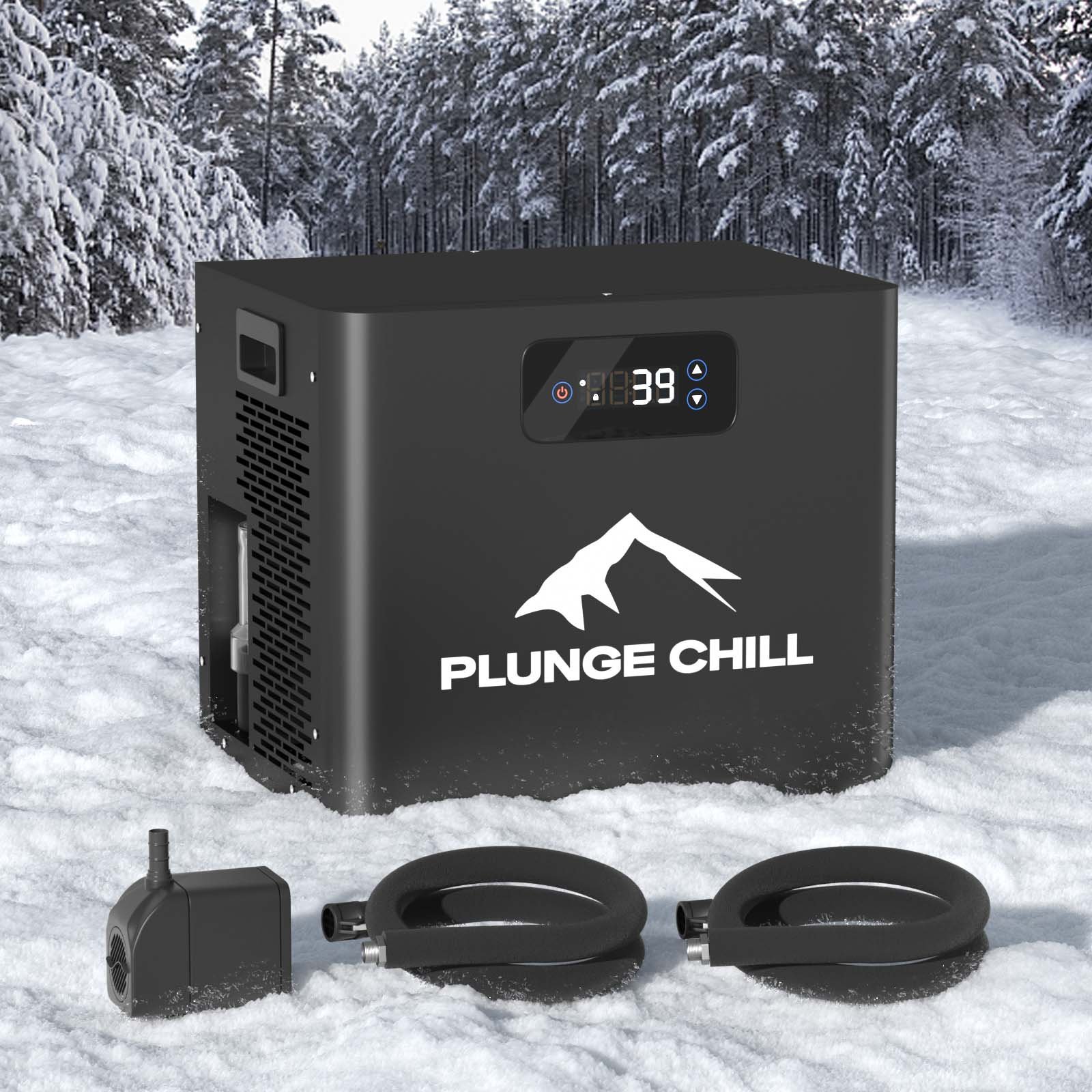
| In the box | Chiller, 2 insulated hoses, power cable, waterproof tape, manual, submersible pump | Manufacturer |
| Filtration | Mesh filter (debris only — no micron rating stated) | Manufacturer |
| Sanitation | None — no ozone or UV | Manufacturer FAQ |
| Safety certification | Not stated anywhere on product page or FAQ | ChillDive research, August 2026 |
| Warranty | Headline: 2 years. Operative remedy described for first year only — confirm in writing | Manufacturer page (see pricing section) |
| Returns | 30 days, light use accepted, no restocking fee, return shipping fee (amount not stated) | Manufacturer |
| Shipping | Free, mainland US, 2–5 days, from NJ/CA/GA warehouses | Manufacturer |
| Trustpilot rating | 4.7 — Excellent (~110–142 reviews, August 2026) | Trustpilot (independently verified) |
Cooling performance — what the numbers actually mean
The manufacturer publishes usable and internally consistent figures, which already puts it ahead of most in this market. On approximately 66 gallons it quotes 75°F down to 50°F in 8–10 hours, and 75°F down to 45°F in 12–14 hours. A separate performance graphic cites 250 litres (66 gal) cooling from 80°F to 42°F in 18 hours at 70°F ambient. These figures are consistent with what a 600 W compressor can deliver.
The feature copy states the unit drops water up to 25°F in 8 hours, and separately that peak performance is 4–5°F per hour. Four degrees an hour over eight hours is 32°F, not 25. The lower figure matches the specification table and is the one to plan against.
How the 1/3 HP sizing stacks up against independent guidance:
| Scenario | Independent recommendation | Plunge Chill 1/3 HP |
|---|---|---|
| 100–150 gal, 70–80°F ambient, targeting 50°F | 1/4 HP adequate | Over-specified — good |
| 150–200 gal, targeting 42–48°F | 1/3 HP | On spec |
| Sustained sub-42°F, or larger tubs | 1/2 HP | Under-specified |
| 250+ gal, or 90°F+ ambient | 3/4–1 HP | Well under-specified |
The headline 39°F minimum is achievable under favourable conditions — the manufacturer’s compatibility guidance of best performance with tubs up to 120 gallons is the number to size against, not the floor temperature. If 50–59°F is your working target, the unit handles considerably more volume than the 39°F headline implies. Research-supported benefits of cold water immersion accumulate across roughly 50–59°F (10–15°C) with no proportional gain from pushing colder — which means this chiller is adequate for the evidence-based range for most buyers.
The sanitation gap — the most important thing to understand
This is the most consequential difference between the Plunge Chill and mainstream chillers, and it is presented on the product page as a feature rather than an omission. The FAQ states: The built-in mesh filter traps leaves, sand, and debris, while 24/7 water flow prevents stagnation. No additives needed.
A mesh filter is a strainer. It removes debris. It does not remove bacteria. Continuous circulation does not disinfect water — it distributes it. A cold plunge is a small volume of water with human bodies in it, which presents the same hygiene challenge as a hot tub, at a temperature that slows but does not stop microbial growth.
| Sanitation layer | Present on Plunge Chill? | What it does |
|---|---|---|
| Mesh / debris filter | Yes — rinse monthly, replace annually | Removes leaves, sand, and visible particulate |
| 20-micron filtration | Not stated | Finer filtration — industry benchmark on mainstream chillers |
| Ozone | No | Oxidises organics and microorganisms; eliminates need for regular draining |
| UV steriliser | No | Inactivates microorganisms in the flow path |
| Chemical sanitiser | Not supplied; page discourages additives | Chlorine, bromine, or H2O2 as residual backup |
What this means in practice: without ozone or UV, ownership involves regular water changes. For a solo indoor user with good hygiene habits, weekly changes on 66 gallons are the realistic minimum. Multiple daily users will need more frequent changes. You can also dose a chemical sanitiser (chlorine, bromine, or hydrogen peroxide) — just confirm compatibility with the manufacturer before adding anything to a unit under warranty, since the page discourages additives.
The Plunge Chill accessory catalogue also sells a filter kit upgrade separately, which suggests the manufacturer is aware filtration is a limitation of the base product. Our full cold plunge water maintenance guide covers every sanitisation approach in detail.
Tub compatibility — the genuine strength
This is where the Plunge Chill earns its position in the market. Most chillers at the $900+ tier are designed for dedicated cold plunge tubs with threaded inlet and outlet ports. The Plunge Chill ships with both a built-in inline pump for ported tubs and a separate submersible pump that drops directly into any tub — a bathtub, a stock tank, an inflatable, or any vessel you already own.
- Two insulated hoses included — not universal at this price, and meaningful for temperature retention and condensation management
- Pre-fitted 1/2 inch male thread adapter
- 35 lb with handles — genuinely portable; can be put away between sessions
- Bathtub note: the submersible pump fitting may need an external thread removed or tube trimmed for standard bathtub use — the manufacturer states this does not affect warranty
The pricing — read carefully
The product is presented as $1,099.00 regular, $499.00 sale, saving $600. The site simultaneously runs a banner reading “Summer Sale: 50% OFF Sitewide.” Every product carries exactly the same discount: tubs at $159→$79, $399→$199, $899→$449, $999→$499. A uniform 50% across an entire catalogue is a pricing structure, not a sale. The product should be evaluated at $449–$499 against competitors at their real prices, not against a list price nobody pays.
At $449–$499 honestly priced, the competitive position is genuinely strong. Standalone mainstream chillers (with ozone/UV) run $899–$2,199. The Plunge Chill is not a discounted version of those — it is a different product at a lower price that competes most directly against hauling ice.
The page announces a 2-Year Usability Guarantee. The sentence that follows describes the remedy for the first year only. These may be reconcilable, but the page does not reconcile them. Get the year-two remedy confirmed in writing before purchasing.
What owners report — Trustpilot 4.7
The Trustpilot profile carried a 4.7 rating across 110–142 reviews observed in early August 2026. This is independently verifiable and holds up to scrutiny. Recurring positive themes across reviews: ease of setup, solid build quality, responsive customer support, and value relative to price.
The negative pattern is specific and worth knowing before purchase. The platform’s own summary of reviewer sentiment notes that several people found the temperature display inaccurate compared with actual water temperature, and that some experienced valve or pump leaks on early runs.
Buy an independent thermometer. A $10 digital probe settles whether your unit is holding what the display shows — this is the single most useful accessory you can add.
Do the leak check on day one. Run a full cycle with paper towels under every fitting and under the unit itself, inside the 30-day return window. If anything weeps, contact support immediately.
One owner specifically reported the chiller holding temperature in Arizona heat — a useful counterweight to the hot-climate caution. Individual reports are not data, but they are worth reading in both directions.
Plunge Chill vs the alternatives
| Option | Price | Sanitation | Hot climate | Portability | Best for |
|---|---|---|---|---|---|
| Ice only | $200–$400 tub + $10–$30/session | N/A | ✓ | ✓ | Testing the habit; occasional use |
| Plunge Chill 1/3 HP | $449–$499 | Mesh only | ⚠️ | Excellent | Budget; bathtub users; temperate climates |
| Vevor 110 Gal 1/3 HP | $389.90 (direct) | None included | ⚠️ | Moderate | Aquarium-heritage, confirmed on 150 gal insulated |
| Mainstream 1/3–1/2 HP (Titan etc.) | $899–$2,199 | 20-micron + ozone/UV | ✓ (1/2 HP) | Moderate | Water quality priority; hot climates; multi-user |
| Integrated system (Plunge All-In) | $7,990+ | Full suite | ✓ | ❌ | Convenience; commercial; premium |
The Vevor 110 Gal at $389.90 is worth a direct mention because it is the closest alternative on price. It is confirmed on 150-gallon insulated cold plunge setups and reaches the same 39°F minimum with R290 refrigerant and a titanium evaporator. Unlike the Plunge Chill, it lacks a submersible pump option (designed for ported tubs) and includes no sanitation. See our full Vevor CL-850 review for a complete comparison.
3-year cost of ownership
One or two users, ~66 gallons, four to five sessions a week, electricity at $0.14/kWh:
| Cost line | Plunge Chill path | Ice path | Mainstream chiller |
|---|---|---|---|
| Equipment | $449–$499 | $0 beyond tub | $899–$2,199 |
| Electricity, 3 years | $540–$1,640 | $0 | Similar or higher |
| Ice | $0 | $6,200–$18,700 | $0 |
| Filters / sanitiser / water changes | Modest — annual filter + water cost | Negligible | Higher filter cost; lower water change frequency |
| 3-year total | $1,150–$2,800 | $6,400–$19,100 | $1,700–$4,600 |
The economic case against ice is overwhelming and any chiller wins it. Against mainstream chillers, the Plunge Chill saves a few hundred dollars upfront and spends it back in more frequent water changes and manual water management. Whether that trade-off is worth it depends entirely on your climate and tolerance for the maintenance cycle.
First 30 days — the test protocol
Everything that matters about this chiller can be tested within the 30-day return window. Do not skip these steps:
- Confirm your outlet is GFCI-protected before the first power-on. If it is not, fix that before using the chiller.
- Run the first cycle with paper towels under every fitting and under the unit itself. Check after one full cycle and again the next morning.
- Place an independent thermometer in the water and record the difference from the display reading. If it exceeds 3–4°F, that is a calibration issue to document and report.
- Time a full pull-down from ambient temperature to your target. Compare against the manufacturer figure of 8–10 hours for 75→50°F on ~66 gallons, adjusted for your actual volume.
- Run it through the hottest day you get in the window. Confirm it holds your target temperature in your actual location.
- That last test is the one that decides it. If it holds, you have a good unit. If it does not, return it rather than living with it.
FAQs
How cold does the Plunge Chill get?
The manufacturer specifies a minimum of 39°F (4°C). This is achievable in favourable conditions — a moderate ambient temperature, a well-insulated tub, good airflow around the unit. The manufacturer’s own compatibility guidance recommends tubs up to 120 gallons for best performance, and independently published cold water immersion research places the evidence-based benefit range at 50–59°F (10–15°C) — well within this chiller’s comfortable operating range for most setups.
Is the Plunge Chill good for hot climates?
The manufacturer states it operates in temperatures up to 95°F. Operating and holding 39°F at 95°F ambient are different claims. Independent sizing guidance recommends 3/4–1 HP for climates above 90°F sustained, and a competing manufacturer rates its own 1/3 HP unit only to 85°F ambient. For a hot climate garage in summer, size up. For an air-conditioned interior space, the 1/3 HP is adequate for most tub sizes.
Does the Plunge Chill work with a regular bathtub?
Yes — it ships with a submersible pump specifically for tubs without inlet/outlet ports, including standard bathtubs. The manufacturer notes that the pump fitting may need a thread removed or tube trimmed for some bathtubs, and confirms this does not affect warranty. This is the single strongest reason to choose the Plunge Chill over alternatives at this price.
How often do I need to change the water?
Without ozone or UV sanitation, water changes are the primary method of keeping water safe. For a solo indoor user with good pre-plunge hygiene: weekly to bi-weekly is the realistic minimum. Multiple daily users will need more frequent changes. Adding a low-dose chemical sanitiser (chlorine, bromine, or hydrogen peroxide) can extend intervals — confirm compatibility with the manufacturer before adding anything under warranty. For the full guide see our cold plunge water maintenance guide.
What is the real price of the Plunge Chill?
$449–$499. The site displays a regular price of $1,099 with a 50% sale, but this discount runs sitewide across every product at all times and represents the actual pricing structure rather than a temporary offer. The countdown timer on the page does not correspond to a real deadline. Evaluate the product at $449–$499 against competitors at their actual prices.
How does the Plunge Chill compare to Vevor?
The Vevor 110 Gal (1/3 HP, $389.90) is the closest alternative on price. It reaches the same 39°F minimum with a titanium evaporator and R290 refrigerant, and is confirmed on 150-gallon insulated cold plunge tubs. It does not include a submersible pump option — it is designed for ported tubs. The Plunge Chill wins on tub compatibility and portability; Vevor wins slightly on price and has a longer documented track record in the cold plunge community. If you have a dedicated tub with ports: Vevor is the better value. If you want to plunge in an existing bathtub or untreated stock tank: Plunge Chill is the better fit. Full comparison: Vevor CL-850 review →
Is cold plunging safe?
For healthy adults, short controlled sessions carry low risk. Cold water immersion triggers an involuntary gasp and hyperventilation on entry — enter slowly and keep your airway clear on first immersion. Do not plunge alone. Do not plunge if you have a fever. Conditions that raise risk meaningfully include cardiac arrhythmias, uncontrolled hypertension, Raynaud’s, peripheral neuropathy, and pregnancy — if any of these apply, speak with a clinician before starting. Nothing in this review is medical advice. For a full discussion of timing, evidence-based benefits, and the important caveat about post-strength-training timing, see our cold plunge temperature and protocol guide.
Also considering the 1HP model? See our Plunge Chill 1HP review — includes the electrical warning and the four product page contradictions.