Plunge Chill 1HP Cold Plunge Chiller Review 2026: The Hot Climate Option (Read the Electrical Warning First)
In this review
- Quick verdict
- The electrical warning — resolve this before ordering
- Four internal contradictions on the product page
- The most interesting finding: the upsell page is more honest
- Full specifications
- 1HP vs 1/3 HP — the decision
- Sanitation: improved but not solved
- vs the mainstream competition at this price
- The pricing, again
- First 30 days protocol
- FAQs
The Plunge Chill 1HP is a materially better machine than its 1/3 HP sibling. It adds 1-micron filtration, a named refrigerant (R410A), a titanium heat exchanger, a rear reset switch, an auto-lock screen, a safety shutoff, and casters. For hot-climate buyers — garage setups in the South and Southwest, outdoor patios where the ambient hits 90°F+ in summer — it is the only Plunge Chill unit that the independent sizing evidence supports.
At the same time, the product page contains four specifications that contradict themselves, and the most consequential one — cooling power in watts — determines whether you need to call an electrician before the unit can run. Read this review before ordering.
For cold plunge safety evidence, benefit claims, and protocol guidance, see our Plunge Chill 1/3 HP review where those sections are covered in full detail.
Quick verdict
One-sentence version
Buy the 1HP if your chiller lives somewhere above 85°F, your tub is over 90 gallons, or more than two people use it regularly — but get the electrical draw confirmed in writing first, because that single figure determines whether the installation needs an electrician.
| Pick | Situation |
|---|---|
| ✅ Buy the 1HP | Hot climate (90°F+ ambient); tub over 90 gallons; 2+ daily users; want reliable 36–45°F in summer |
| ⚠️ Buy the 1/3 HP instead | Single user; air-conditioned space; tub under 80 gallons; target 45–55°F; the $600 price difference buys headroom you won’t draw on |
| ❌ Cross-shop first | At ~$1,049–$1,099 you are in the mainstream chiller tier, where 20-micron filtration, UV sanitation, and app control are standard inclusions. See the competition section. |
⚠️ The electrical warning — resolve this before ordering
This is the section to read before anything else. The product page states a maximum cooling power of 2,600 W and separately 2,700 W in the comparison table. It never states whether that figure is electrical input power or thermal cooling capacity. Those are completely different numbers with very different consequences for your installation:
| If 2,600 W is… | Electrical draw at 120V | Circuit needed | Monthly electricity (50% duty cycle) |
|---|---|---|---|
| Electrical input power | ~21.7 A | Exceeds a 15A circuit — needs 20A dedicated or 240V | ~$150–$200+ |
| Thermal cooling capacity | ~6–8 A (700–900W actual input) | Standard 15A GFCI circuit | ~$25–$45 |
The product FAQ states electricity usage of approximately 4.25 kWh to cool water from 90°F to 39°F. At the stated 5°F/hour cooling rate, that takes about 10 hours. Ten hours of genuine 2,600W electrical draw = 26 kWh — six times the stated figure. The 4.25 kWh figure is thermodynamically consistent with 2,600W being cooling capacity. But a direct competitor (Titan Wellness) lists 2,600W for its comparable 1HP unit explicitly under Power Usage. The page does not resolve this. Ask: “What is the electrical input in watts and amps, and what circuit does this require?” Get it in writing. The difference between the two scenarios is potentially several thousand dollars in electrical work and running costs over three years.
Whatever the answer, independent guidance for this category is clear: chillers draw surge current and are incompatible with shared circuits. Plan on a dedicated, GFCI-protected outlet within 1.5m of the tub regardless of the steady-state draw.
Four internal contradictions on the product page
This is not a reason to distrust the product — most of these resolve toward the more conservative figure — but they are a reason to verify before planning against any single number.
| Specification | Version A | Version B | Which to plan against |
|---|---|---|---|
| Cooling power | 2,600W (Key Features + spec list) | 2,700W (comparison table + electricity FAQ) | 2,600W — the lower figure |
| Tank volume | Up to 110 gal (Key Features + specs) | ≤200 gal (comparison table) | 90–150 gal per FAQ — the most conservative |
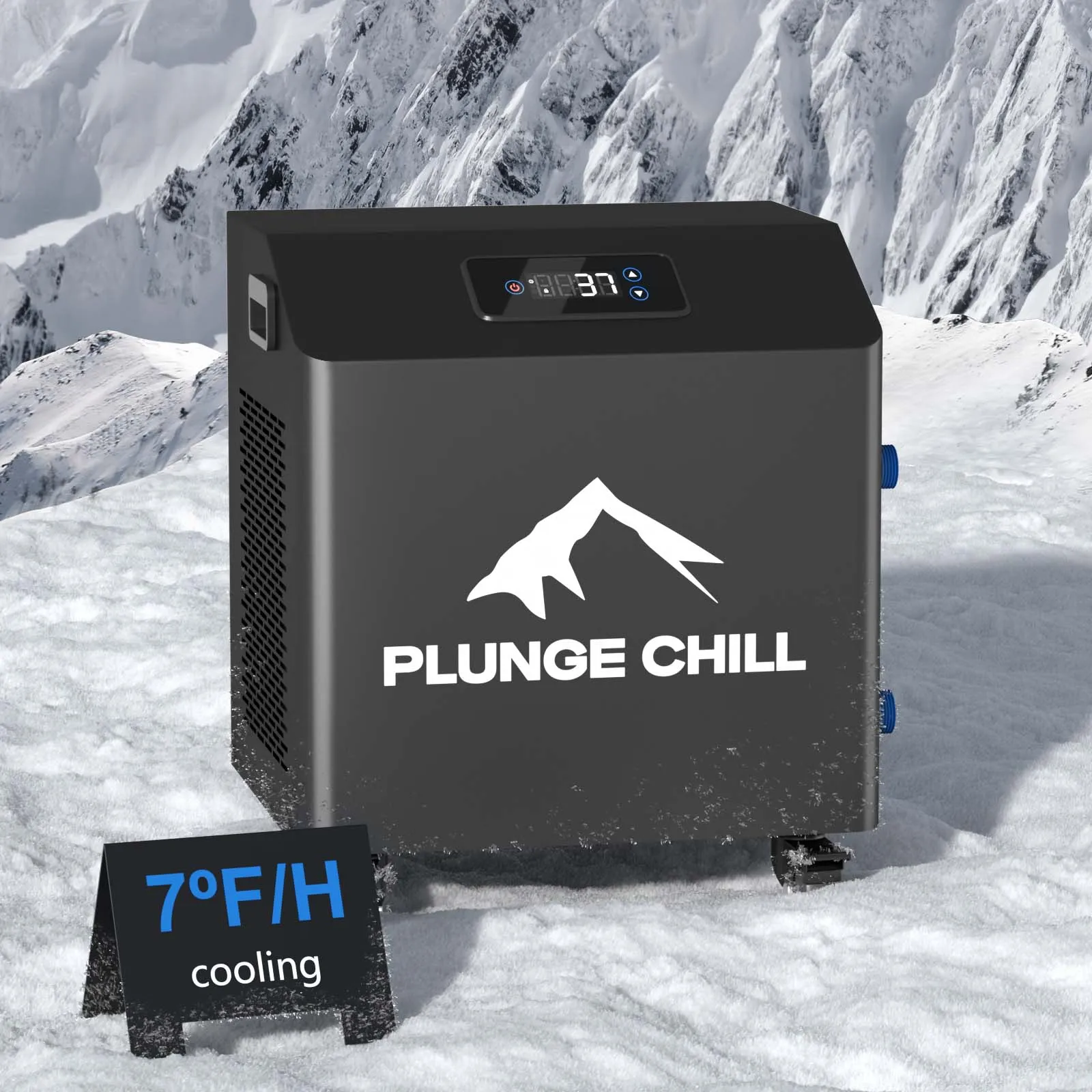
| Cooling rate | Up to 5°F/hour (stated twice in prose) | 7°F/hour (hero image caption) | 5°F/hour — stated twice, consistent with pull-down data |
| Ambient limit | 0–95°F (comparison table) | Weather-tested for year-round outdoor use, unqualified | 95°F — and not in direct sunlight per the table note |
The most interesting finding: the upsell page is more honest about the 1/3 HP
This only becomes visible when you read both product pages together. The comparison table on the 1HP page describes the 1/3 HP unit differently from that product’s own page — and the comparison table figures match independent sizing guidance more closely.
| 1/3 HP specification | On the 1/3 HP’s own page | On the 1HP comparison table |
|---|---|---|
| Minimum temperature | 39°F | 42°F |
| Tank volume | Best with ≤120 gallon tubs | ≤66 gallons |
| Ambient ceiling | Operates to 95°F | 0–85°F |
A competing manufacturer rates its own 815W 1/3 HP unit for climates only up to 85°F. Independent sizing guidance places 1/3 HP at 150–200 gallons targeting 42–48°F. The comparison table figures — 42°F, 66 gallons, 85°F ambient — align with that guidance more closely than the 1/3 HP’s own page does. When a seller’s comparison table is less flattering to a product than that product’s own page, the comparison table is usually closer to the truth. It also means the real gap between these two machines is wider than the headline horsepower ratio suggests.
Full specifications
| Specification | Value | Notes |
|---|---|---|
| HP rating | 1 HP | Manufacturer |
| Stated cooling power | 2,600W (or 2,700W) | Whether this is input power or cooling capacity — ask before ordering |
| Minimum temperature | 36°F (2°C) | Manufacturer — page notes going below 36°F risks freezing the water |
| Best-performance volume | 90–150 gal (per FAQ); 110 gal headline; 200 gal comparison table | Use 90–150 gal for planning |
| Cooling rate | 5°F/hour (stated twice); 7°F/hour (image caption) | Use 5°F/hour for planning |
| Refrigerant | R410A | Named — an improvement over the 1/3 HP which does not disclose |
| Heat exchanger | 20-foot titanium coil | Corrosion-resistant; appropriate for treated or salted water |
| Filtration | 1-micron inline filter | Finer than the 20-micron benchmark; not disinfection |
| Safety hardware | Rear reset switch, auto-lock screen, overheat/abnormal-power safety shutoff | Absent from the 1/3 HP unit |
| Mobility | Caster wheels | 73 lb — casters are necessary at this weight |
| Weight | 73 lb unit; 83 lb shipping | Two-person unbox |
| Dimensions | 16.5” L × 13.8” W × 18.9” H | Clearance required: 10–12” on all sides — plan ~37” × 34” of floor |
| In the box | Chiller, 3 insulated water pipes, external filter and pump, submersible pump, install kit, manual | 3 hoses vs 2 on the 1/3 HP |
| Noise level | Not quantified | Described as “comparable to a small air conditioner” — a regression from the 1/3 HP’s stated 39–45 dB |
| Safety certification | Not stated | Same gap as the 1/3 HP — ask for UL 1082 or IEC 60335 |
| Warranty | 2-Year headline; first-year remedy described in text | Same language discrepancy as the 1/3 HP — confirm year-two remedy in writing |
| Price | $1,099 advertised; ~$1,049 with welcome code | Regular price of $2,199 is the permanent 50% off structure, not a sale |
1HP vs 1/3 HP — the honest decision
The decision rule from the source research:
- Your unit lives somewhere that regularly exceeds 85°F ambient (the upsell page’s own figure for the 1/3 HP limit)
- Your tub is over roughly 90 gallons
- More than two people use it regularly — recovery rate between sessions is what horsepower actually buys
- You want reliable sub-45°F performance in summer
- One or two users
- Air-conditioned or mild-climate location (below 85°F most of the year)
- Tub under roughly 80 gallons
- Target temperature 45–55°F
The $600 difference in that scenario buys headroom you will never draw on. See the 1/3 HP review for the full assessment.
| Feature | Plunge Chill 1/3 HP | Plunge Chill 1HP |
|---|---|---|
| Price with code | ~$449 | ~$1,049 (+$600) |
| Ambient ceiling (per upsell page) | 85°F | 95°F |
| Minimum temperature | 42°F (per upsell) / 39°F (own page) | 36°F |
| Volume (conservative) | ≤66 gal (per upsell) | 90–150 gal |
| Filtration | Mesh strainer | 1-micron inline filter |
| Refrigerant disclosed | No | R410A |
| Reset switch / safety shutoff | No | Yes |
| Mobility | 35 lb with handles | 73 lb with casters |
| Claimed longevity | 12,000 hours | 20,000 hours |
On chasing 36°F: Review-level evidence places measurable cold plunge benefits across roughly 50–59°F (10–15°C), with no proportional gain toward freezing — what colder water adds is a stronger cold-shock response and higher arrhythmia risk. The reason to buy the 1HP is not to reach 36°F. It is to hold 50°F effortlessly on a day when the garage is 100°F, with multiple people using it. The seller says as much in its own “Built for Hot Climates” section. That is the honest case for this unit.
Sanitation: improved but not solved
The 1-micron inline filter is a genuine step up from the 1/3 HP’s mesh strainer, and 1 micron is actually finer than the 20-micron benchmark most competitors advertise at this price. But filtration removes particulates — it does not inactivate bacteria. There is no ozone or UV on this unit.
| Sanitation layer | Plunge Chill 1/3 HP | Plunge Chill 1HP | Mainstream competitor |
|---|---|---|---|
| Filtration | Mesh strainer | 1-micron inline filter | 20-micron (less fine than 1-micron) |
| Ozone | No | No | Common |
| UV | No | No | Common |
| App / WiFi control | No | No | Common |
| Water routine | Regular draining | Longer between changes, still manual | Maintain rather than drain |
The 1HP still requires regular water changes without ozone or UV as a backup sanitation layer. The 1-micron filter extends the interval compared to the 1/3 HP, but you will still be draining and refilling rather than maintaining. For water management guidance see our cold plunge water maintenance guide.
vs the mainstream competition at this price
At $1,049–$1,099 the Plunge Chill 1HP is no longer in the budget category — it sits in the mainstream standalone chiller tier alongside units from Titan Wellness and others. That is a different competitive context than the 1/3 HP faces.
| Feature | Plunge Chill 1HP (~$1,049) | Mainstream 1HP competitors (~$900–$2,199) |
|---|---|---|
| Filtration | 1-micron (finer than category norm) | 20-micron (category norm) |
| Ozone / UV sanitation | None | Common at this tier |
| App / WiFi control | None | Common at this tier |
| Safety certification | Not stated | More commonly disclosed |
| Noise level disclosed | Not quantified | Usually stated in dB |
| Component provenance | Named: Japanese compressor, titanium coil, aluminium condenser (USA) | Rarely disclosed at this level |
The Plunge Chill 1HP wins on filtration fineness and component disclosure. It loses on sanitation, app control, and published certification. Whether that trade-off works for you depends on how much the water-management convenience of ozone/UV matters relative to the 1-micron filtration advantage.
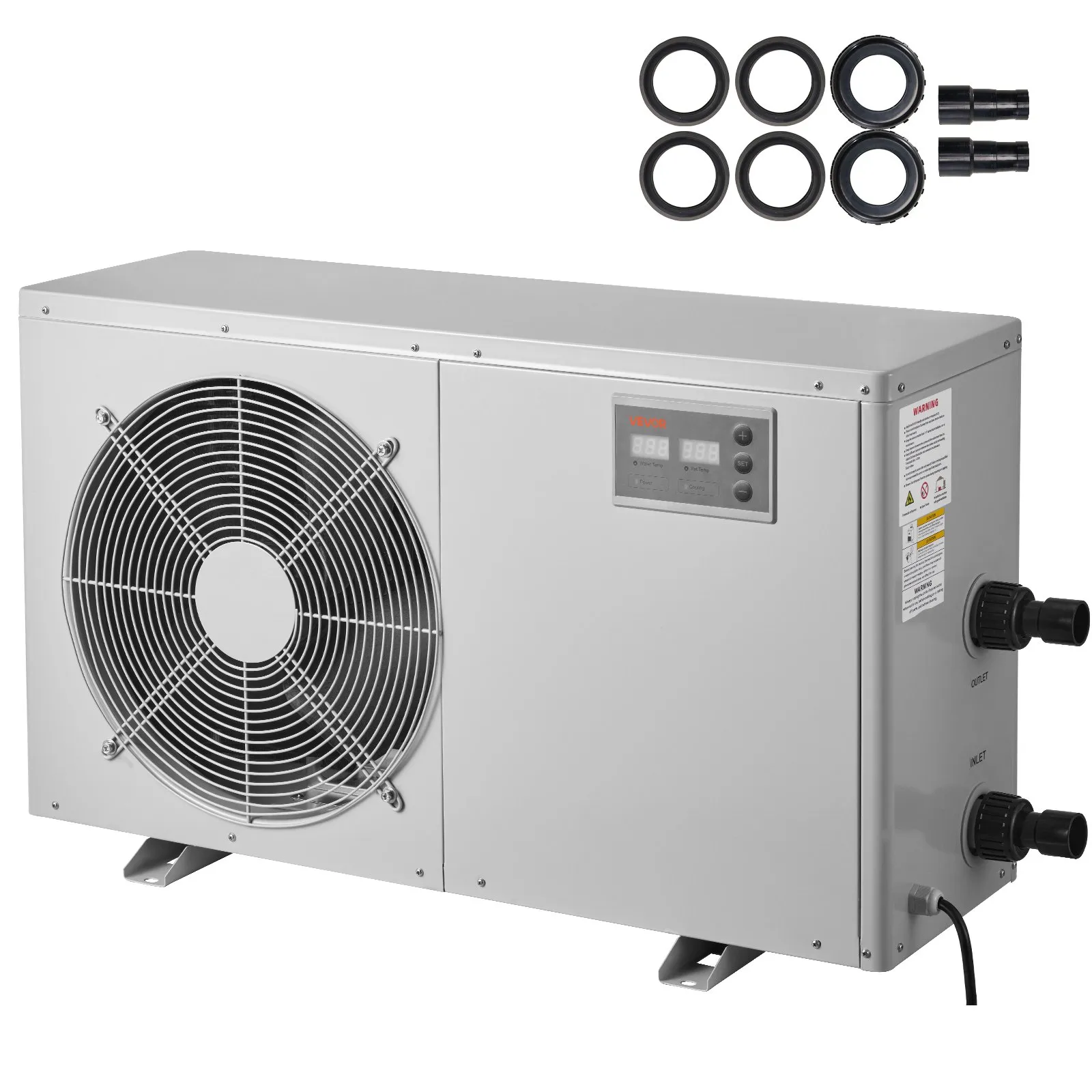
An aquarium-heritage 1.5HP chiller confirmed at 48°F on 150-gallon insulated cold plunge setups in 90°F Florida heat. Less feature-rich than the Plunge Chill 1HP (no submersible pump option, no 1-micron filter) but competitively priced and well-documented in real outdoor conditions.
View on Vevor — $905.90 →The pricing, again
The same caveat from the 1/3 HP review applies here. The product is listed at $2,199 regular and $1,099 sale, with a sitewide “Summer Sale: 50% OFF” banner that runs permanently across every product. This is a pricing structure. Evaluate the 1HP at $1,049–$1,099 against competitors at their real prices — at that level it is a mid-range unit competing with the mainstream standalone tier, not a discounted premium product.
First 30 days — the tests that matter
- Check the rating label on arrival — it should state the electrical input in amps and the required circuit voltage. This settles the 2,600W question definitively without relying on support email.
- Confirm your outlet is GFCI-protected and matches what the label demands before first power-on.
- Plug in an energy meter for the first week. This answers the running cost question better than anything on the product page.
- Place an independent thermometer in the water and record the difference from the display. Owner reviews on the 1/3 HP note display inaccuracy; assume the same pattern until proven otherwise.
- Paper towels under every fitting on the first run. Check after one cycle and again the next morning.
- Run a timed pull-down from ambient to target. Compare against the stated 8 hours for 110 gallons from 80°F to 40°F, scaled for your actual volume.
- Test it on your hottest day in the window. Holding temperature in your actual location is what you are paying the premium for.
- If the electrical draw, the display accuracy, the noise level, or the hot-weather holding performance disappoints — return it within 30 days rather than living with it.
FAQs
What is the difference between the Plunge Chill 1HP and 1/3 HP?
Beyond horsepower, the 1HP adds 1-micron filtration (vs mesh strainer), R410A refrigerant (disclosed vs undisclosed), a titanium heat exchanger, a rear reset switch, auto-lock screen, safety shutoff, and casters. The 1HP’s own comparison table also rates the 1/3 HP more conservatively than that product’s own page does — 42°F vs 39°F minimum temperature, 66 gal vs 120 gal volume, and 85°F vs 95°F ambient ceiling. The gap between the two units is wider than the headline HP ratio suggests. See the full 1/3 HP review.
Does the Plunge Chill 1HP need a special electrical circuit?
This is unresolved on the product page. The stated 2,600W cooling power figure could be thermal cooling capacity or electrical input — the page does not specify. The FAQ’s own electricity usage estimate (4.25 kWh for a full cool-down) points strongly toward 2,600W being cooling capacity rather than electrical draw. However, verify by asking the seller for the electrical input in watts and amps, and check the rating label on the unit when it arrives. Either way, a dedicated GFCI-protected outlet is required — do not share the circuit with other appliances.
Is the Plunge Chill 1HP good for a hot garage?
Yes — this is the buyer the product is designed for. Independent sizing guidance places 3/4–1 HP as the minimum for 90°F+ sustained ambient, and the Plunge Chill’s own comparison table concedes the 1/3 HP tops out at 85°F. The 1HP is rated to operate to 95°F, which covers most US garage setups. Provide 10–12 inches of clearance on all sides, avoid direct sunlight on the unit, and confirm GFCI protection.
Does the Plunge Chill 1HP have ozone or UV?
No — it has a 1-micron inline filter, which is finer than the 20-micron standard most competitors advertise. Filtration removes particulates; it does not inactivate bacteria. Without ozone or UV, water management is still manual — you will need regular water changes or a chemical sanitiser as a backup. For the full sanitation guide see our cold plunge water maintenance guide.
How cold does the Plunge Chill 1HP get?
The manufacturer specifies 36°F (2°C) as the minimum. The FAQ notes that going below 36°F risks freezing the water and damaging the system. Research-supported benefits of cold water immersion accumulate across roughly 50–59°F — the reason to buy the 1HP is not to reach 36°F, but to hold 50°F reliably in a hot-climate setup or with multiple daily users.
How does the Plunge Chill 1HP compare to a Vevor?
The Vevor 500 Gal 1.5HP ($905.90) is the closest alternative on capacity and HP class. It is confirmed on 150-gallon insulated cold plunge tubs at 48°F in 90°F Florida ambient, uses R32 refrigerant and a titanium evaporator, and costs less than the Plunge Chill 1HP with the welcome code. It does not include a 1-micron filter or a submersible pump option. The Plunge Chill wins on filtration fineness and bathtub/portless-tub compatibility; Vevor wins on price and documented outdoor performance data. See our Vevor 1.5 HP review.