Cold Plunge Water Maintenance Guide: Filter, Pump, Sanitizer & Ozone (2026)

In this guide
- Why water maintenance matters
- How fast does cold plunge water get dirty?
- Filtration: filter types and what each does
- The circulation pump: flow rates and sizing
- Sanitizers: chlorine, bromine, hydrogen peroxide
- Ozone generators: the low-chemical option
- UV sterilizers
- How often to change the water
- Putting it all together: a complete filter system
- FAQs
Cold plunge water maintenance is the part of DIY cold plunge ownership nobody talks about until something goes wrong. Unlike a hot tub or pool, cold plunge water sits at temperatures that slow — but do not stop — bacterial growth. Body oils, skin cells, sweat, and environmental debris accumulate with every session. Without a proper filtration and sanitation system, water quality degrades quickly, leading to cloudy water, biofilm buildup, and in some cases genuine health risks from bacterial contamination.
This guide covers everything you need to keep your cold plunge water clean, clear, and safe: filtration options, pump sizing, sanitizer choices, ozone and UV systems, and how often to do full water changes.
Why water maintenance matters for cold plunge
Cold water is not sterile. While low temperatures do inhibit the growth of many pathogens compared to hot tub temperatures, common waterborne bacteria including Pseudomonas aeruginosa (the cause of folliculitis, commonly called “hot tub rash”) can survive and multiply at cold plunge temperatures if the water is not properly sanitized. The conditions that promote contamination are exactly what a cold plunge provides: high-contact water, regular human immersion, and water sitting at temperatures too warm for bacteriostasis but too cold for the aggressive chemical doses used in hot tubs.
The good news is that cold plunge water maintenance is simpler than hot tub maintenance. Lower temperatures mean lower chemical demand, less frequent water changes, and easier filtration. The components and chemistry are well understood — the same principles used in pools and hot tubs apply, just at smaller scale and lower intensity.
How fast does cold plunge water get dirty?
The rate of contamination depends on several factors:
- Number of users per day — a solo daily user generates far less load than a household of three using the plunge before and after workouts
- Pre-rinse habits — showering before plunging dramatically reduces the organic load introduced per session
- Tub exposure — outdoor tubs collect debris, pollen, insects, and sunlight-driven algae growth; indoor or covered tubs stay cleaner
- Water temperature — colder water (below 50°F) suppresses microbial growth better than water at 58–65°F
For a solo indoor user with good pre-rinse habits and a basic filter, water can stay clear and safe for 2–4 weeks before a full change. For multiple daily users outdoors without filtration, water may need changing after just a few days. A proper filtration and sanitation system extends water life to 4–8 weeks regardless of conditions.
Shower before you plunge. Use a filter and a sanitizer. Test water weekly with a simple test strip. Change water when it becomes visually cloudy or test strips show pH and sanitizer levels out of range despite chemical addition. With this approach, most users change water every 4–8 weeks.
Filtration: filter types and what each does
Filtration removes physical debris, biofilm, and some microorganisms from the water. It is distinct from sanitation — filtration does not kill bacteria, it removes particles. Both are needed for a complete system.
Sediment / mechanical filter
The simplest and most common filter type for cold plunge. A cartridge or bag filled with filter media (foam, fibrous material, or fine mesh) captures physical debris: skin cells, hair, dirt, and particulate matter. Mechanical filters are inexpensive ($20–$60), easy to rinse clean, and should be the starting point for any cold plunge filtration system.
Flow rate requirement: your filter must be sized for at least your pump’s GPH output. A filter rated at 300 GPH fed by a 600 GPH pump will bypass water around the filter and provide limited filtration.
Biofilter (biological filter)
Used in aquariums and ponds, biofilters colonize beneficial bacteria that break down ammonia and organic waste through nitrification. In a cold plunge, biofilters are rarely necessary given the lower bio-load compared to an aquarium. Some all-in-one filter units combine mechanical and biological media — these are fine to use but the biological component adds minimal benefit at cold plunge temperatures and usage patterns.
Activated carbon / charcoal filter
Activated carbon removes chloramines (the chlorine by-products responsible for that “pool smell”), many organic compounds, and some heavy metals from the water. It also removes chlorine itself, which can be a problem if chlorine is your primary sanitizer — carbon filtration and chlorine sanitation work against each other. Carbon filters work well in ozone or hydrogen peroxide systems where residual chemical sanitation is less critical.
All-in-one filter and pump units
Several brands including Eonix and others sell integrated pump-plus-filter units designed specifically for cold plunge use. These combine mechanical filtration, sometimes activated carbon, and a circulation pump in one housing. They are convenient but typically limited in filter media volume. Users with multiple daily sessions often add a secondary filter inline to increase filtration capacity.
The circulation pump: flow rates and sizing
The circulation pump moves water from the tub, through the filter and chiller, and back. Adequate flow rate is essential: too low and filtration is ineffective; too high and you create turbulence and pressure issues.
How to size your pump
The standard recommendation for pool and spa filtration is to turn over the full water volume at least once every 6 hours, ideally once every 4 hours. For a 100-gallon cold plunge:
- Turn over every 6 hours: 100 gal ÷ 6 hrs = 16.7 GPM = 1,000 GPH minimum
- Turn over every 4 hours: 100 gal ÷ 4 hrs = 25 GPM = 1,500 GPH
For a 60-gallon cold plunge, a 600–900 GPH pump is adequate. Most Vevor-style aquarium chillers ship with a pump in the 264–660 GPH range which is borderline for 80–100 gallon setups — consider upgrading to a 800–1,200 GPH submersible pump if you have a larger tub or multiple daily users.
Submersible vs external (inline) pump
Submersible pumps sit inside the tub and push water out. They are simple to install and included with most aquarium chiller packages. The downside: every watt of electrical power the pump consumes becomes heat deposited directly into the cold water, increasing the chiller’s workload. For cold plunge at 50–55°F, a 100W submersible pump adds meaningful heat load over an extended run.
External (inline) pumps sit outside the tub and pull water through an inlet line. They add zero heat to the water, are easier to service, and can handle longer pipe runs. They are more expensive and require priming before first use. For serious setups or commercial cold plunge installations, external inline pumps are worth the additional cost.
Sanitizers: chlorine, bromine, and hydrogen peroxide
Sanitizers kill bacteria, viruses, and other microorganisms in the water. Unlike filtration, they address what you cannot see. All three options below are used successfully in cold plunge applications:
Chlorine (dichlor granules)
The most widely used pool and spa sanitizer. Dichlor granules (sodium dichloro-s-triazinetrione) dissolve readily in cold water and are easy to dose. The target free chlorine level for a cold plunge is 1–3 ppm, same as a pool. At cold plunge temperatures, chlorine dissipates more slowly than in a heated spa, so less frequent dosing is required.
Pros: inexpensive, widely available, fast acting, easy to test with standard strips.
Cons: forms chloramines when reacting with organic matter (the “chlorine smell”); skin and eye irritation at higher levels; degrades activated carbon filters; some users prefer to avoid chemical exposure during wellness protocols.
Recommended dose: 1 teaspoon of dichlor granules per 100 gallons weekly, adjusted based on test strip results. Maintain pH 7.2–7.6 for chlorine efficacy.
Bromine
Bromine is stable over a wider pH range than chlorine and does not produce the same chloramine odor compounds. It is the traditional choice for hot tubs and works well in cold plunge applications. Bromine tablets are slow-dissolving and typically used in a floating dispenser or inline feeder.
Pros: more stable than chlorine at varying pH; less odor; gentler on skin for many users.
Cons: more expensive than chlorine; slower to activate; can leave a faint bromine smell; requires a bromine bank to be established before the system works efficiently.
Target level: 3–5 ppm bromine.
Hydrogen peroxide (H2O2)
Food-grade hydrogen peroxide (35%, diluted) is a popular chemical-free-feeling sanitizer for cold plunge users who prefer to avoid chlorine and bromine. At 50–100 ppm concentration in the water, it effectively kills bacteria and breaks down into water and oxygen — no chloramine formation, no residual chemical odor.
Pros: no chlorine or bromine; no disinfection by-products; compatible with activated carbon filters; attractive to wellness-focused users.
Cons: more expensive per treatment than chlorine; unstable — breaks down quickly in sunlight and organic load; requires more frequent testing; can irritate skin at concentrations above 100 ppm; must use food-grade (not drugstore) H2O2 for water applications.
Target level: 50–100 ppm. Test weekly with H2O2-specific test strips (standard chlorine strips do not measure hydrogen peroxide).
Sanitation comparison at a glance
| Sanitizer | Target level | Cost | Odor | Best for |
|---|---|---|---|---|
| Chlorine (dichlor) | 1–3 ppm | Low | Mild chlorine | Budget setups, multiple users |
| Bromine | 3–5 ppm | Medium | Faint bromine | Those sensitive to chlorine smell |
| Hydrogen peroxide | 50–100 ppm | Medium-high | None | Wellness-focused, ozone-paired systems |
Ozone generators: the low-chemical option
Ozone (O3) is one of the most powerful sanitizers used in water treatment — more effective at killing bacteria, viruses, and biofilm than chlorine at comparable concentrations, and it breaks down into plain oxygen with no chemical residue. An ozone generator injects ozone directly into the water flow, where it oxidizes and destroys organic matter and microorganisms before breaking down.
For cold plunge, an ozone generator can dramatically reduce or eliminate the need for chemical sanitizers. Many serious cold plunge users run an ozone system as their primary sanitation, with a small amount of hydrogen peroxide as a residual backup. Chlorine is generally not recommended with ozone as the two react and consume each other.
How ozone generators work
The ozone generator is installed in the water return line between the pump and the tub. As water flows through, ozone gas is injected via a venturi or injector fitting. Contact time in the line allows ozone to sanitize the water before it returns to the tub. Because ozone breaks down rapidly (half-life of minutes), there is no ozone residual in the water during use — you plunge into clean water with no chemical.
Sizing an ozone generator
Ozone generators for cold plunge and spa applications are typically rated by ozone output in milligrams per hour (mg/hr). For a cold plunge tub of 60–100 gallons, a unit rated at 200–500 mg/hr is adequate. Larger or heavily used tubs benefit from 500–1,000 mg/hr units.
Key ozone installation notes
- Ozone is corrosive to certain materials — use ozone-resistant tubing (vinyl or EPDM, not standard PVC)
- The ozone contact chamber or mixing line should allow at least 30 seconds of contact time before water returns to the tub
- Ozone generators require a dry installation environment — moisture damages the ozone-producing component
- Run the ozone system continuously during filtration cycles, not only during plunge sessions
UV sterilizers
UV sterilizers use ultraviolet light to damage the DNA of microorganisms, preventing them from reproducing. A UV lamp is installed in the return water line where water passes through a clear sleeve exposed to UV-C light (254nm wavelength).
UV sanitation is highly effective against bacteria, viruses, and algae, and like ozone, leaves no chemical residue in the water. However, UV sanitation only treats water passing through the unit in that moment — it provides no residual protection in the tub itself. UV is best used as a complement to a residual sanitizer (low-dose chlorine or hydrogen peroxide) rather than as a standalone system.
UV vs ozone
| Feature | UV sterilizer | Ozone generator |
|---|---|---|
| Kills bacteria | Yes — in the unit | Yes — in line and brief tub residual |
| Kills viruses | Yes | Yes |
| Breaks down organics | No | Yes |
| Chemical residual | None | None (breaks down to O2) |
| Reduces chemical need | Partially | Significantly |
| Cost (unit) | $30–$100 | $50–$200 |
| Installation complexity | Low — inline fitting | Low-medium — requires injector |
| Lamp/bulb replacement | Annually | None (electrode lasts 2–5 years) |
For most DIY cold plunge setups, an ozone generator is the better investment. For setups where ozone installation is impractical (very short return lines, portable setups), a UV unit provides meaningful supplemental sanitation at low cost.
How often to change the water
Even with a complete filtration and sanitation system, cold plunge water accumulates total dissolved solids (TDS) over time — minerals, chemical by-products, and organic compounds that filtration cannot remove. When TDS becomes too high, sanitizers become less effective and the water can feel harsh or irritating.
| Setup | Water change frequency |
|---|---|
| No filter, no sanitizer | Every 2–7 days depending on users and exposure |
| Filter only (no sanitizer) | Every 1–2 weeks |
| Sanitizer only (no filter) | Every 2–4 weeks |
| Filter + sanitizer (chlorine or bromine) | Every 4–8 weeks |
| Filter + ozone + low-dose sanitizer | Every 6–12 weeks |
| Filter + ozone + UV + low-dose sanitizer | Every 8–16 weeks |
The practical trigger: change the water when it becomes visually cloudy despite correct chemical levels, when test strips show TDS is elevated, or when you cannot maintain correct sanitizer levels despite dosing. Most experienced cold plunge users settle into a quarterly full change cycle with a complete filter, ozone or UV, and low-dose chemical backup.
Putting it all together: a complete cold plunge water system
A complete cold plunge water management system has four components working together:
Maintains your target temperature 24/7. Eliminates warm water that accelerates bacterial growth. See our Vevor cold plunge chiller guide and 1/4 HP vs 1/2 HP sizing guide for chiller selection.
Circulation pump sized to turn over full water volume every 4–6 hours. Cartridge or bag filter rated to match pump output. Rinse filter media monthly; replace every 3–6 months. Run continuously — do not turn off between sessions.
Installed in the return line between filter and tub. Ozone is more effective at breaking down organics; UV is simpler to install. Either dramatically reduces chemical demand. Run whenever the pump runs.
Low-dose chlorine (1 ppm), bromine (2–3 ppm), or hydrogen peroxide (50 ppm) as residual backup. Test weekly with test strips. Maintain pH 7.2–7.6. Adjust alkalinity if pH is unstable. This backstop protects against anything the ozone or UV misses.
Weekly maintenance checklist
- Test free sanitizer level and pH with test strips
- Add sanitizer or pH adjustment chemicals as needed
- Visually inspect water clarity
- Check filter for debris; rinse if flow appears reduced
- Confirm pump, ozone/UV, and chiller are running normally
Monthly maintenance checklist
- Remove and rinse filter cartridge or media thoroughly with clean water
- Wipe down tub walls to remove any biofilm ring at the waterline
- Test TDS (total dissolved solids) with a TDS meter; consider a partial water change if TDS exceeds 1,500 ppm
- Inspect all hose connections for drips or loosening
- Clean chiller condenser fins of dust (see our Vevor chiller maintenance guide)
The Vevor chiller advantage for filtration
Vevor’s compact aquarium chillers include a titanium evaporator that resists biofilm and mineral buildup better than copper or stainless alternatives. Running continuous filtration through the chiller’s circuit keeps water moving through the titanium heat exchanger, which further reduces biofilm accumulation at the cooling surface. This means the chiller serves double duty — cooling the water and maintaining circulation through the filter system.
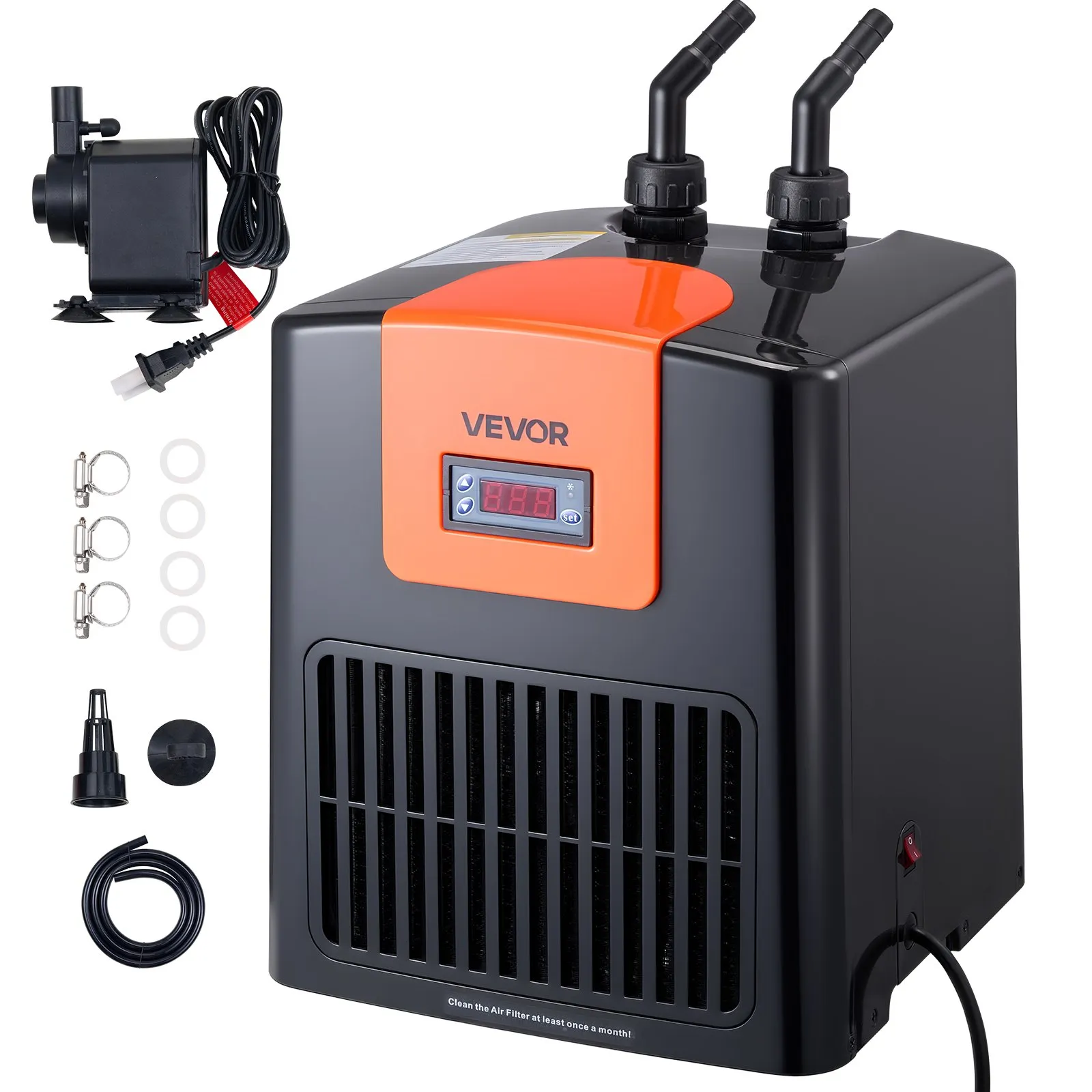
Pump included. Titanium evaporator. For tubs under 52 gallons.
View on Vevor →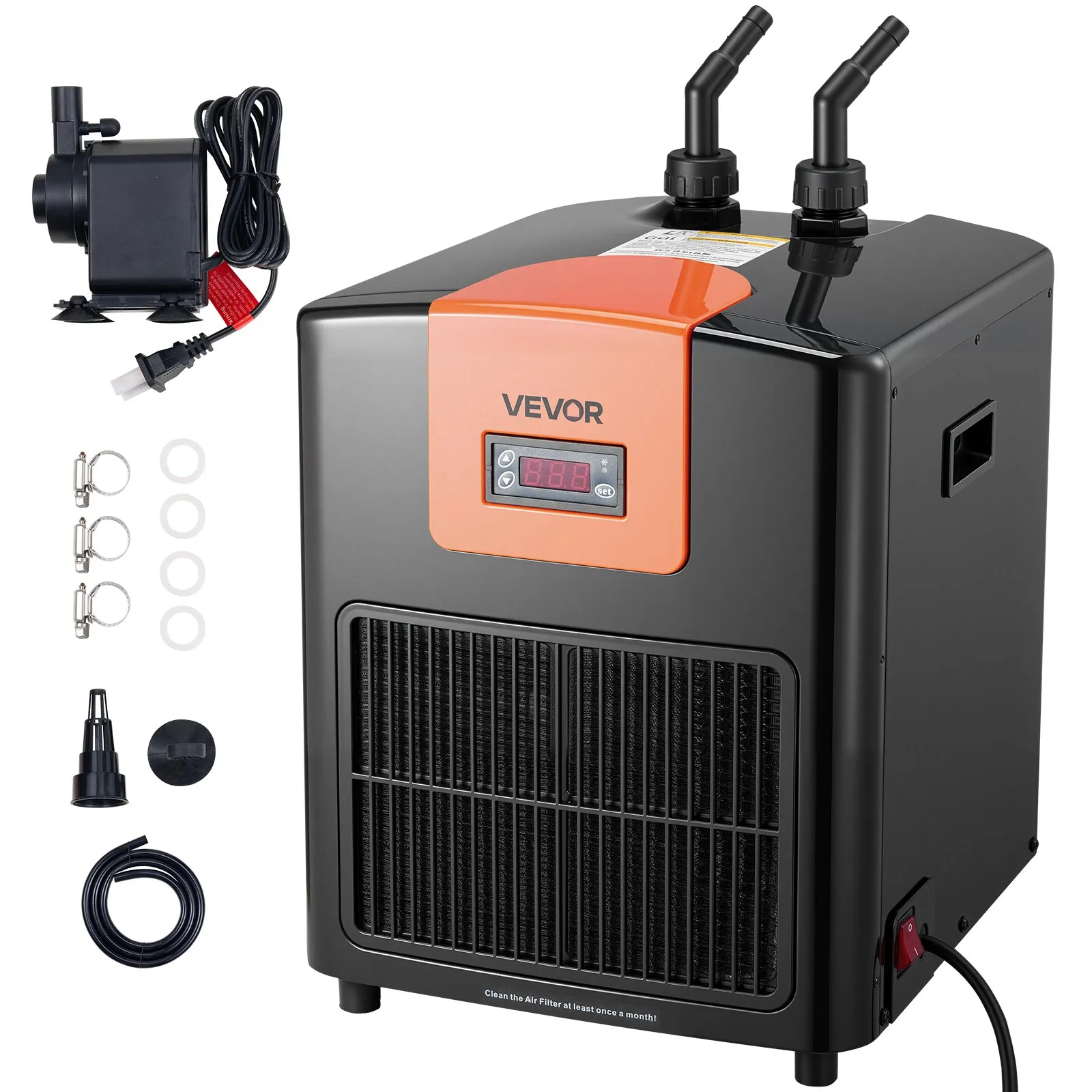
Pump included. Titanium evaporator. For tubs up to 110 gallons.
View on Vevor →Building a new cold plunge? See our complete DIY cold plunge build guide for containers, insulation, chiller selection, and plumbing.
FAQs
What filter do I need for a cold plunge?
A basic mechanical cartridge filter rated to match your pump’s GPH output is the minimum. For 60–100 gallon tubs, a filter rated at 600–1,500 GPH covers most setups. If you want to reduce chemical use, add an ozone generator or UV sterilizer inline. The filter catches physical debris; the ozone or UV kills microorganisms; a low-dose chemical residual provides backup protection.
How do I keep my cold plunge water clean without chemicals?
The closest to chemical-free is an ozone generator combined with a mechanical filter. Ozone is a powerful sanitizer that breaks down to plain oxygen with no residue. Combined with good filtration and showering before each plunge, many users maintain clean water for 6–12 weeks with minimal or no added chemicals. UV sterilizers work similarly but provide no residual. A very small amount of hydrogen peroxide (25–50 ppm) as backup is recommended even in ozone/UV systems to cover periods when the pump is not running.
How often should I change cold plunge water?
With a complete system (filter + ozone + low-dose chemical), most users change water every 4–12 weeks. Without filtration, water typically needs changing every 1–2 weeks. The practical trigger is water clarity and test strip results: change when you cannot maintain correct sanitizer levels or when water becomes visually cloudy.
What pump flow rate do I need for a cold plunge?
Size your pump to turn over the full water volume every 4–6 hours. For a 100-gallon tub: 100 ÷ 6 hours = ~1,000 GPH minimum. For 60 gallons: ~600 GPH. Most Vevor chillers ship with a 264–660 GPH pump — adequate for smaller tubs; consider upgrading to 800–1,200 GPH for larger setups or multiple daily users.
Can I use an ozone generator with my cold plunge chiller?
Yes — ozone generators work well with any cold plunge chiller. Install the ozone injector in the return line after the filter and before the tub. The ozone sanitizes the water in the line before it returns. Use ozone-resistant tubing (vinyl or EPDM). Do not combine ozone with chlorine as they neutralize each other; use hydrogen peroxide as your residual backup instead.
What chemicals should I use in a cold plunge?
Three main options: chlorine (dichlor granules, 1–3 ppm), bromine (tablets, 3–5 ppm), or hydrogen peroxide (food-grade 35%, diluted to 50–100 ppm in the tub). Chlorine is cheapest and most available. Bromine is odorless and more pH-stable. Hydrogen peroxide appeals to those who prefer no halogens and works well paired with ozone. All require weekly testing with appropriate test strips.
How do I clean a cold plunge tub?
For routine cleaning: wipe the waterline monthly with a soft cloth to remove biofilm ring buildup. Rinse the filter cartridge monthly. For a deep clean before a water change: drain the tub, spray with a diluted hydrogen peroxide or white vinegar solution, scrub with a soft brush, rinse thoroughly, and refill. Never use standard household cleaners (bleach, dish soap) directly in the tub as residuals interfere with water chemistry and can irritate skin.
What is a cold plunge water stabilizer?
A cold plunge water stabilizer refers to products that prevent pH from swinging up or down between sessions — most commonly sodium bicarbonate (baking soda) as an alkalinity increaser, or sodium bisulfate (dry acid) to lower pH. Stable pH (7.2–7.6) is essential because sanitizers like chlorine and bromine lose effectiveness outside this range. Without adequate alkalinity (ideally 80–120 ppm), pH bounces wildly with each chemical addition and becomes difficult to control. Add 1 tablespoon of sodium bicarbonate per 100 gallons, test, and repeat until total alkalinity reads 80–120 ppm before adjusting pH itself. Some brands sell proprietary cold plunge water stabilizer products at a premium — these are typically sodium bicarbonate or sodium carbonate with a cold plunge label. Standard pool alkalinity increaser does the same job at a fraction of the cost.
How often should I replace my cold plunge filter cartridge?
For most cold plunge setups with a single daily user: rinse the filter cartridge monthly with clean water and replace it every 3–6 months, or when flow rate noticeably decreases despite rinsing. Signs it’s time to replace: the cartridge feels slimy or discoloured even after rinsing, or the pump is straining and water circulation is reduced. Cartridges are typically $10–$25 each — replacing on schedule is far cheaper than a new pump from running at reduced flow. For multiple daily users or outdoor setups with higher debris load, inspect monthly and replace every 6–8 weeks. Keep a spare cartridge on hand so downtime between replacements is zero.
Is a cold plunge filter the same as an aquarium filter?
Functionally yes — the same filtration principles apply. Many cold plunge builders use aquarium filters, pond filters, and hot tub filter cartridges interchangeably. The key specs to match are: flow rate (GPH) adequate for your tub volume turnover, physical size that fits your plumbing, and filter media type appropriate for your sanitation approach (avoid activated carbon if using chlorine as primary sanitizer).
Is it safe to cold plunge when you are sick?
The short answer is: it depends on what is wrong and how sick you are. For a mild cold with no fever, many experienced cold plungers continue their routine without issue. Cold water immersion causes a short-term spike in cortisol and norepinephrine that some people find temporarily clears congestion. However, there are important caveats: do not cold plunge if you have a fever (cold plunging while febrile can interfere with your body’s temperature regulation response); do not cold plunge if you feel significantly weak, dizzy, or have a chest infection; and be aware that the physiological stress of cold immersion diverts resources from immune function in the short term. If you are fighting something serious, rest is more effective than cold therapy. For a mild head cold with no systemic symptoms, a shorter plunge at a slightly warmer temperature (58–62°F rather than your usual 50–55°F) is a reasonable middle ground. When in doubt, skip the session and rest — one missed plunge does not undo your progress.