Vevor 1.5 HP Water Chiller (500-Gallon) for Cold Plunge: Full Review 2026
In this guide
The Vevor 1.5 HP aquarium chiller has become the default recommendation in the DIY cold plunge community for one reason: it delivers cold plunge-capable performance on 100–200 gallon vessels at $400–$550, where the nearest capable competitors start at $600–$800 and dedicated cold plunge chillers run $1,000–$2,000+.
This review is built on real-world user data, verified field performance reports, and a thorough analysis of the two distinct variants Vevor sells under nearly identical names — a distinction that is critical and frequently missed by buyers. Read the warning in section 1 before you buy anything.
⚠️ Critical: Two variants exist — only one works for cold plunge
Read this before purchasing. This is the most common and costly mistake buyers make.
Vevor sells two 1.5 HP chiller configurations under nearly identical product names and images. They have different refrigerants and different temperature ranges:
| Variant | Refrigerant | Min temp | Cold plunge use? |
|---|---|---|---|
| Variant A | R134a | 65°F (18°C) | ❌ Cannot reach cold plunge temperatures |
| Variant B | R32 | 50°F (10°C) | ✓ Suitable for cold plunge |
Before purchasing, confirm the refrigerant type on the specific product listing. The R32 variant is the one you need. The R134a variant is designed for tropical aquariums and will not reach cold plunge temperatures under any conditions.
Overview — Model S2TL3500, R32 refrigerant
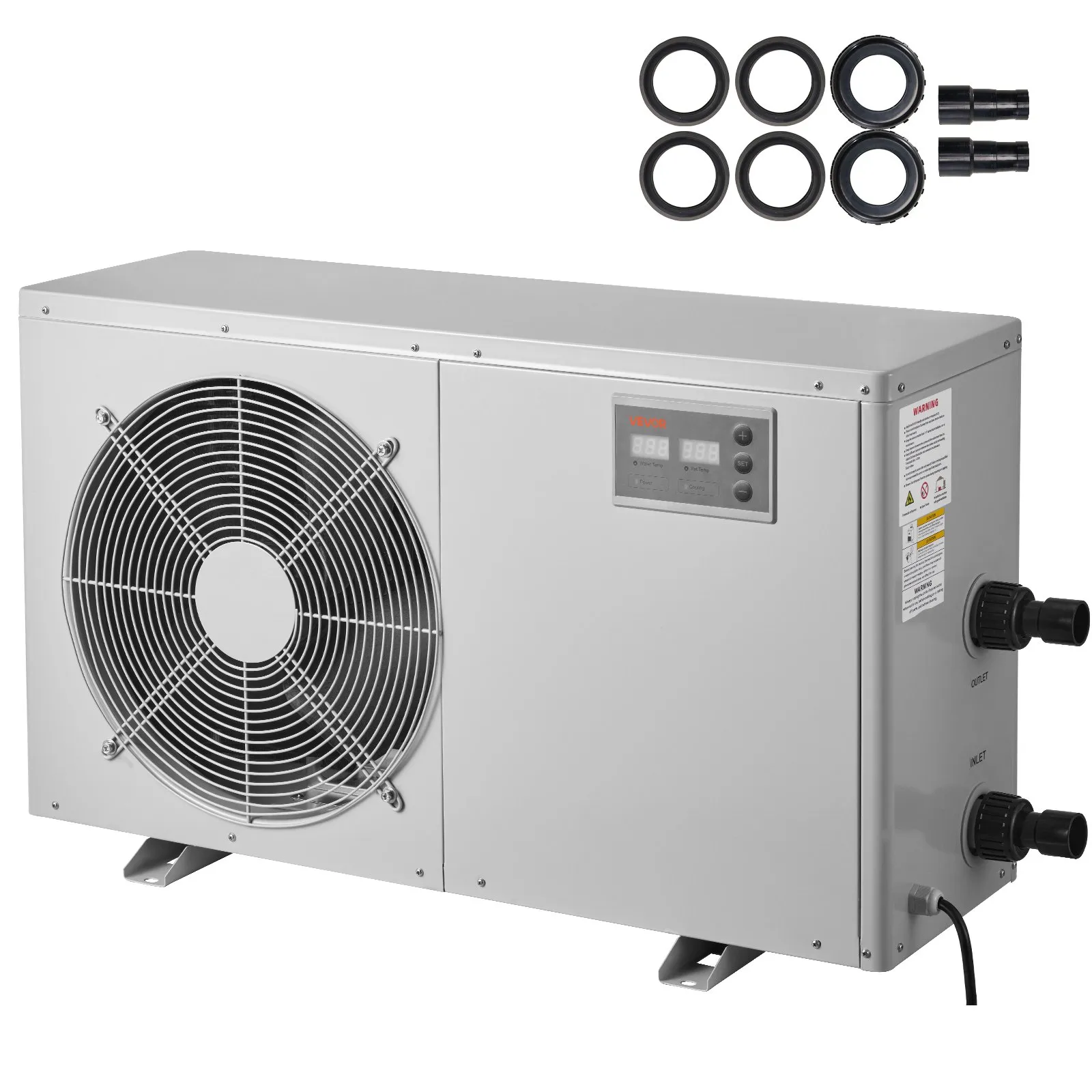
The Vevor 1.5 HP (R32 variant) is an outdoor-style split chiller originally designed for large reef aquariums, hydroponic systems, and live seafood tanks. Its 500-gallon rated capacity and 1.5 HP compressor make it capable of handling the water volumes most DIY cold plunge builds use: 100–275 gallons in Rubbermaid stock tanks, chest freezer conversions, and IBC tote builds.
This is a fundamentally different product from Vevor’s compact black aquarium-series chillers (the 52-gallon and 110-gallon models). Those are small, quiet, indoor-friendly units that include a pump. The 1.5 HP is a full-size outdoor split unit — larger fan condenser, higher flow requirements, no pump included, and significantly more cooling capacity.
Who it is for
- DIY cold plunge builders using 100–200 gallon vessels (stock tanks, IBC totes, chest freezer conversions)
- Outdoor setups in warm or hot climates where the compact models lack headroom
- Builders targeting 50–60°F — the standard cold plunge range
- Anyone who wants maximum cooling capacity at the lowest price point in this tier
Who it is NOT for
- Builders targeting sub-50°F consistently on large volumes in hot ambient conditions — this unit has a 50°F minimum and will struggle below that on large volumes outdoors in summer
- Small tubs under 80 gallons — the 1.5 HP is significantly oversized; use the 52-gallon or 110-gallon compact models instead
- Indoor setups where fan noise and condenser heat exhaust are a concern
Full specifications (R32 variant)
| Specification | Detail |
|---|---|
| Compressor power | 1.5 HP (~1.1 kW) |
| Refrigerant | R32 (cold plunge variant) — lower GWP HFC |
| Temperature range | 50–80°F (10–27°C) |
| Minimum temperature | 50°F (10°C) — manufacturer rated |
| Rated capacity | 500 gallons (1,892 liters) |
| Required flow rate | 1,585 GPH (6,000 L/H) minimum |
| Connections | 1-inch NPT inlet and outlet |
| Pump included | No — external pump required (see below) |
| Evaporator material | Titanium on premium variant; standard on base |
| Noise level | <65 dB |
| Ventilation clearance | 24 inches on all sides (minimum) |
| Power supply | Standard 120V household outlet (~9–10 amps) |
| Dimensions (approx.) | 32” × 20” × 14” |
| Weight | ~60 lbs |
| Warranty | 1 year factory warranty (Vevor standard) |
Real-world temperature performance (official Vevor data)
Vevor’s own documentation includes a real-world performance table that explains the most common user complaint — the gap between set temperature and actual water temperature. This is a sizing and ventilation issue, not a hardware fault:
| Set temperature | Typical actual result | Cause & fix |
|---|---|---|
| 36°F | ~55°F actual | Water volume too large or ambient too high — reduce water volume |
| 47°F | ~63°F actual | Same cause — reduce volume and improve ventilation |
| 49°F | ~68°F actual | Chiller operating near thermal limit for current volume/ambient combination |
| 53°F | ~76°F actual | Volume far exceeds capacity at this ambient — insulate vessel and reduce volume |
The fix in every case is to reduce water volume, improve ventilation clearances, or insulate the vessel. For full troubleshooting see our Vevor chiller troubleshooting guide →
Real-world cold plunge performance (user reports)
The following data is compiled from verified user reviews on Vevor’s product page and the broader DIY cold plunge community. These are field results, not manufacturer test conditions.
| Setup | Ambient temp | Volume | Result | Notes |
|---|---|---|---|---|
| Rubbermaid stock tank, spray foam insulated | 90°F (Florida, outdoor) | 150 gal | 48°F maintained | User compares favourably to Aqua Euro quarter-HP; fraction of the price |
| Stock tank, garage, Florida | Warm garage | 80 gal | Cold plunge temp overnight | 80°F tap water cooled to target in ~12 hours; no issues |
| Unspecified insulated vessel | Not stated | 125 gal | 43°F stable | User ordered a second unit for a second tank; minimal electricity cost noted |
| Unspecified vessel | Not stated | 129 gal | 55°F maintained | No meaningful increase in electricity bill; recommends to others |
| Axolotl tank (indoor, climate-controlled) | ~70°F indoor | Not stated | 64°F target held | Notes faint sweet smell on startup — see known issues |
Performance summary
- 100–130 gallons with basic insulation: consistently achieves 43–55°F across a range of ambient conditions
- 150 gallons in 90°F outdoor Florida: 48°F maintained — the benchmark result that made this chiller the DIY community’s standard recommendation
- 275-gallon IBC tote: will maintain 50–60°F reliably with good insulation; sub-50°F consistently on 275 gallons in hot ambient requires additional insulation or the R32 unit at its limits
- Electricity cost: multiple users specifically note no meaningful increase in power bills, consistent with a 1.1 kW compressor at typical duty cycles
Installation guide
What you need (not included)
- External submersible pump rated 1,585+ GPH (Danner Supreme 1200 recommended, ~$35–50)
- 1-inch reinforced flexible hose (spiral-wound; standard garden hose is not adequate at this flow rate)
- Stainless steel hose clamps (minimum 4)
- GFCI outdoor-rated outlet for outdoor/garage installations
- Level, stable surface with 24 inches of clearance on all sides
Step-by-step setup
- Position the chiller on a flat surface adjacent to the vessel with 24 inches of clearance on all sides. The condenser fan exhausts significant warm air — in an enclosed garage this heat accumulates and reduces chiller efficiency. Outdoors or in a ventilated space is ideal.
- Install the pump in your vessel. Connect 1-inch reinforced hose from the pump outlet to the chiller inlet fitting.
- Connect the return line from the chiller outlet back to the vessel. Position the return outlet low in the vessel and on the opposite side from the intake to encourage circulation.
- Secure all connections with stainless steel hose clamps — tightened with a screwdriver, not just hand-tight. A connection failure at 1,585 GPH will drain the vessel.
- Prime the system by filling the vessel and running the pump for several minutes to confirm no air locks and all fittings are leak-free before activating the chiller.
- Set the target temperature on the digital control panel. The compressor activates approximately 3 minutes after power-on — this is normal.
- Allow 4–12 hours for initial chill depending on starting water temperature, ambient conditions, and vessel volume.
The ventilation mistake
This is the most common installation error. The condenser rejects heat to the surrounding air through a fan. In an enclosed unventilated space, ambient temperature rises as the session continues — the chiller is then working against its own waste heat, reducing efficiency in a compounding cycle. Leave the garage door open, install a wall vent, or position the chiller outdoors. Never enclose it in a decorative cabinet without active ventilation.
The insulation multiplier
Insulation on the vessel is the single variable that most affects whether this chiller reaches and holds target temperature. Multiple field users achieved 48–55°F specifically because they insulated their stock tanks with spray foam. The same chiller on an uninsulated vessel in the same conditions would run continuously without reaching target.
- 2 inches of closed-cell spray foam on a 150-gallon stock tank: achieves 48°F in 90°F ambient where the uninsulated same tank would reach ~58–62°F
- An insulated lid is the highest-priority single insulation investment — the open water surface is the largest heat exchange surface in the system
- Rule of thumb: for every 10°F you want to reduce below ambient, add one more inch of insulation on the vessel exterior
Is the 1.5 HP the right chiller for your build?
| Build | Target temp | Ambient | 1.5 HP fit | Recommendation |
|---|---|---|---|---|
| 60–100 gal vessel | 50–60°F | Any | Overkill | Use Vevor 52-gal or 110-gal compact model instead — cheaper and sized correctly |
| 100–150 gal stock tank | 45–55°F | Indoor or mild outdoor | Excellent match | The sweet spot for this unit. Confirmed 48°F on 150 gal in Florida heat. |
| 150–275 gal vessel | 50–60°F | Indoor garage / shaded outdoor | Good match | Insulate the vessel well. Will reach and hold 50–55°F reliably. |
| 150–275 gal vessel | 37–45°F | Hot outdoor (85°F+) | Marginal | May struggle sub-50°F on 275 gal in high ambient. Consider two units or a dedicated plunge chiller. |
| 275+ gal (large IBC tote) | 55–65°F | Indoor / shaded | Functional | Works for upper cold plunge range. Initial chill may take 8–12+ hours from ambient. |
| Any vessel | Below 45°F reliably on large volumes | Hot ambient (90°F+) | Wrong tool | A dedicated cold plunge chiller with sub-45°F design rating is required for this scenario. |
Vevor 1.5 HP vs. competing chillers
| Chiller | Price | HP | Min temp | For volume | Verdict |
|---|---|---|---|---|---|
| Vevor 1.5 HP (R32) | $400–$550 | 1.5 HP | 50°F | 100–200 gal effective | Best price-to-performance for this tier |
| Vevor 110 Gal, 1/3 HP | $389.90 | 1/3 HP | 39°F | Up to 110 gal | Better min temp, pump included, right for smaller builds |
| EcoPlus 1.0 HP | $450–$700 | 1.0 HP | ~46°F | Up to 200 gal | Lower min temp than Vevor 1.5 HP; higher cost |
| Dedicated cold plunge chiller | $800–$2,000+ | 1.0–1.5 HP | 37–40°F | 100–200 gal | Best for sub-40°F targets; significantly higher cost |
The Vevor 1.5 HP value proposition in one sentence: it achieves 50–60°F on 100–200 gallon DIY cold plunge vessels for $400–$550 — where the nearest capable competitors start at $600 and dedicated units run $1,000–$2,000.
The trade-offs: 50°F minimum temperature floor (not sub-50°F), pump not included (~$35–50 additional), ventilation-sensitive, and the R134a variant trap that catches uninformed buyers.
Known issues
The sweet smell on startup
One user review notes: “it has a smell that emits from it when it kicks on, like kinda a sweet smell but strong where it burns my eyes if I’m sitting by it.” This is a known characteristic of some refrigerant-based chillers: the refrigerant oil used in the compressor can produce a faint sweet or petroleum smell when the compressor activates. This is not a safety hazard in well-ventilated environments but can be unpleasant at close range in enclosed spaces. Position the condenser exhaust facing away from the plunge area. A sweet smell that becomes stronger over time may indicate a refrigerant or oil leak — contact Vevor support if this occurs.
50°F temperature floor
The R32 variant’s 50°F minimum is a real ceiling for most users. For sub-50°F targets on large volumes in warm ambient: reduce water volume, use a heavily insulated vessel, operate in a cool environment, or combine the chiller with occasional ice addition.
Pump not included
Standard for aquarium chillers but a surprise for first-time buyers. Budget $35–80 for a Danner Supreme 1200 or equivalent pump rated 1,585+ GPH.
Parts shipping delays
One user review noted receiving an incomplete kit requiring a 3-week wait for replacement parts. Order with adequate lead time and verify all components on delivery.
Electrical requirements
The 1.5 HP compressor draws ~9–10 amps on a 120V circuit. A standard 15-amp household outlet is adequate for the chiller alone. Use a GFCI outdoor-rated outlet for any outdoor or garage installation. Avoid extension cords; if required, use a 12-gauge outdoor extension cord rated for the load.
Maintenance schedule
| Task | Frequency | Procedure |
|---|---|---|
| Clean condenser fins | Monthly | Soft brush or compressed air on condenser fins. Clogged fins are the most common cause of underperformance over time. |
| Check hose connections | Monthly | Inspect all connections for weeping or dripping. Retighten hose clamps. Replace hoses showing cracking. |
| Inspect titanium evaporator | Quarterly | Check for scale deposits. Descale with citric acid solution (1 tbsp per liter, circulate 30 minutes, flush) if scale is visible. |
| Verify temperature accuracy | Quarterly | Compare chiller display to an independent thermometer in the vessel. More than 3°F discrepancy indicates sensor cleaning or recalibration may be needed. |
| Check refrigerant performance | If cooling degrades | If the chiller runs continuously without reaching set point under previously successful conditions, refrigerant charge may have degraded. Contact Vevor support. |
| Winter storage | Before freezing temps | Drain all water from the heat exchanger by tilting the unit and running the pump briefly. Store in a frost-free location. Trapped water will freeze and crack the heat exchanger. |
Verdict
Model number: S2TL3500 (R32 refrigerant). The Vevor 1.5 HP R32 aquarium chiller is the best-value option in the DIY cold plunge chiller market for builds in the 100–200 gallon range targeting 50–60°F. The field-confirmed result of 48°F on a 150-gallon stock tank in 90°F Florida heat makes the case as clearly as any lab test.
Having trouble with your unit? See our complete Vevor chiller troubleshooting guide for every symptom including temperature calibration (CA mode) and the common installation mistakes that cause 90% of issues.
The R134a variant distinction is the most important piece of information on this page. Buying the wrong variant is a $400–$550 mistake. Confirm R32 refrigerant before purchasing.
The 50°F minimum is the honest limitation. For sub-50°F targets on large volumes in hot climates, a dedicated cold plunge chiller is the right tool. For the majority of DIY builders targeting 50–60°F, the Vevor 1.5 HP R32 is the correct choice.
Vevor Aquarium Chiller 500 Gallon, 1-1/2 HP
Confirm R32 variant before purchasing. 50°F minimum temperature. External pump required (not included) — add Danner Supreme 1200 (~$40).
$905.90 at Vevor
View on Vevor →For smaller DIY builds under 110 gallons, the compact black Vevor models are better suited — they reach 39°F (not just 50°F), include a pump, and are quieter for indoor use:
FAQs
How do I know if I have the R32 or R134a Vevor chiller?
Check the product listing before purchasing — look for the refrigerant type in the specifications. On the physical unit, the refrigerant type is printed on the compressor data plate. R32 is the cold plunge-capable variant with a 50°F minimum. R134a has a 65°F minimum and cannot reach cold plunge temperatures.
Does the Vevor 1.5 HP chiller come with a pump?
No — unlike Vevor’s smaller compact aquarium chillers (52-gallon and 110-gallon), the 1.5 HP outdoor unit does not include a pump. You need an external submersible pump rated for at least 1,585 GPH. The Danner Supreme 1200 ($35–50) is the DIY community’s standard recommendation for this application.
Can the Vevor 1.5 HP chiller reach below 50°F?
The R32 variant is rated to 50°F minimum. In practice, users report 43–48°F on 100–130 gallon insulated vessels in moderate ambient conditions — the chiller is being pushed below its manufacturer rating in these cases via small volume and good insulation. For consistent, reliable sub-50°F on larger volumes in warm climates, this unit is not the right tool.
How long does initial cool-down take?
Starting from ambient tap temperature (~65–70°F), the 1.5 HP unit brings a 150-gallon well-insulated tank to 50°F in approximately 4–8 hours depending on ambient conditions. On 275 gallons, budget 8–12+ hours for the initial chill. Subsequent sessions maintain temperature with the compressor cycling normally.
What is the electricity cost of running this chiller daily?
The 1.5 HP compressor draws ~1.1 kW at full load. At typical US electricity rates and a 30–50% duty cycle once at temperature, expect $10–20 per month for daily cold plunge use. Multiple real-world users specifically note no meaningful increase in their electricity bills.
How much ventilation clearance does the Vevor 1.5 HP need?
A minimum of 24 inches on all sides. The condenser fan exhausts significant warm air — in an enclosed garage, this heat accumulates and reduces chiller efficiency. Always ensure adequate air circulation around the unit.
What vessels work best with the Vevor 1.5 HP?
100–150 gallon Rubbermaid or Tarter stock tanks are the most commonly used vessels with this chiller and produce the best-documented performance results. IBC totes (275 gallons) work for upper cold plunge temperatures (50–60°F) with good insulation. Chest freezer conversions in the 80–150 gallon range are also popular — the freezer provides excellent insulation that improves chiller performance significantly.