Aquarium Chiller for Axolotls: Sizing Guide, Flow-Rate Fix & Heat Emergency Protocol 2026
In this guide
- Do you actually need a chiller?
- Temperature danger table
- Sizing the chiller — the BTU formula
- The flow-rate conflict nobody warns you about
- Chiller types: compressor vs thermoelectric
- Alternatives, honestly assessed
- Installation and placement
- Heat spike emergency protocol
- Common mistakes
- Buying checklist
- FAQs
Target water temperature: 60–64°F (16–18°C)
Sizing formula: gallons × 8.3 × °F drop needed = BTU/hr, then add 15–20%
Axolotls are among the most temperature-sensitive animals in captivity. A normal, comfortable house — 68–72°F — produces water temperatures in the danger zone without anything going wrong. Your pump motor, lights, and ambient room temperature are all adding heat to the tank. This guide covers whether you actually need a chiller, how to size one correctly, and — most importantly — how to solve the problem nobody else in this niche addresses: the conflict between what a chiller needs and what an axolotl can tolerate.
Do you actually need a chiller?
Before spending anything, measure your tank water temperature — not room temperature — at the warmest point of the warmest day, in late afternoon.
| What you measure | What it means |
|---|---|
| Consistently under 68°F | You probably do not need a chiller. Keep monitoring through summer. |
| Peaks 68–72°F | Try passive methods first (fans, AC, relocated tank). A chiller may not be necessary. |
| Regularly above 72°F | You need active cooling. A chiller is the only method that holds stable temperature without supervision. |
Plenty of keepers in cool climates or air-conditioned homes never need a chiller. Plenty of keepers in warm climates absolutely do — and no amount of fans and frozen bottles will substitute long-term.
Temperature danger table
| Temperature | What happens |
|---|---|
| 60–64°F (16–18°C) | Ideal. Metabolism, immune function and dissolved oxygen all sit where they should. |
| 65–68°F (18–20°C) | Tolerable. Upper 60s warrants closer monitoring. |
| Above 68°F sustained | Heat stress begins. Immune system suppressed. Fungal infections invited. |
| 70–72°F (21–22°C) | Most axolotls become visibly stressed — stop eating, become lethargic, may float at the surface. Often mistaken for illness when temperature is the actual cause. |
| Above 72°F (22°C) | Rapid health decline. One husbandry reference reports death within a day or two if not corrected. |
| Above 74–75°F (23–24°C) | Genuine danger. VCA notes sluggishness, abnormal floating, and greatly increased infection susceptibility above 75°F. |
| 76°F (24°C) | Fatal fungal infections documented developing within one week (SmallPetExpert, 2026). |
| Sudden drop below 50°F | Cold shock. Gradual cooling is tolerated; sudden drops are not. |
You will see 68°F, 72°F, 74°F, and 75°F all cited as danger points. They describe different stages: 68°F is where SUSTAINED exposure suppresses the immune system; 72°F is where most animals show VISIBLE stress; 75°F is where CLINICAL signs and rapid decline appear. The takeaway is not to pick one number — it is that the margin between comfortable and dangerous is roughly ten degrees, and most homes sit inside it.
Veterinary teams and rescue-community keepers consistently report that fungal gill infections cluster June through September, correlating directly with elevated tank temperatures. One reference frames it bluntly: warm-water fungal infections in axolotls are almost entirely preventable infrastructure failures, not bad luck or weak animals. Keepers in warm climates should have a cooling plan in place before summer begins. Source: ExoPetGuides, 2026.
Sizing the chiller — the BTU formula
Most axolotl chiller advice says something like “get a 1/10 HP for a 20-gallon tank.” This is guesswork. The actual calculation takes two minutes and produces a result you can trust.
The formula
BTU/hr = gallons × 8.3 × °F drop needed
Then add 15–20% for equipment heat and ambient variation. Source: Bulk Reef Supply.
Worked example
| Step | Value |
|---|---|
| Tank volume | 40 gallons |
| Warmest observed water temperature | 76°F |
| Target temperature | 63°F |
| Drop needed (ΔT) | 13°F |
| Base calculation | 40 × 8.3 × 13 = 4,316 BTU/hr |
| Add 15–20% for equipment and ambient | ~5,000 BTU/hr |
Simplified rule: 10 BTU per gallon per °F of drop. On the example: 40 × 10 × 13 = 5,200 BTU/hr. Same answer with margin baked in. Use whichever you prefer. Source: Bulk Reef Supply chiller guide.
What you must include in the volume calculation
| Factor | Effect | How to account for it |
|---|---|---|
| Sump or canister volume | Adds to total system water — a 75-gal tank with a 40-gal sump needs chilling for 130 gal, not 75 | Add sump/canister volume to tank volume before calculating |
| Pump heat | Every watt a submerged pump consumes becomes heat in the water | Watts × 3.41 = BTU/hr added. Add to your required BTU load. |
| Lighting heat | LED runs cooler, but any light over the tank adds heat | Apply same watt × 3.41 formula for lights above or in the tank |
| Room temperature | The chiller’s job is defined by ambient, not by tank setpoint alone | Size for the hottest afternoon of the year, not the annual average |
Manufacturer specs assume ideal lab conditions at a ΔT of 10°F. In practice, a 1/10 HP chiller may deliver only about 60% of its rated output at a ΔT of 5°F. Axolotl keepers frequently need a large ΔT — pulling 76°F water down to 63°F is a 13° drop, well beyond the light duty many small units are optimised for. Treat “recommended tank size” on the box as marketing. Size from your own BTU math. Source: aquarium chiller buying guides, 2026.
The flow-rate conflict nobody warns you about
Chillers require a minimum water flow to work. Most 1/3 HP units perform optimally at 150–200 GPH; larger units need more. Running below the minimum risks freezing inside the heat exchanger.
Axolotls require low flow. They are lake-bottom animals from still water, with delicate external gills. Strong current stresses them, causes constant hiding, and can damage gill filaments.
So you have a device demanding high flow, attached to an animal that cannot tolerate it. Generic aquarium chiller guides never mention this because reef tanks want high flow. The solutions are below.
Four ways to resolve it
| Approach | How it works | Best for |
|---|---|---|
| Dedicated chiller loop ⭐ | A separate small pump feeds the chiller and returns to the tank through a wide, diffused outlet. The chiller gets its flow; the tank does not see a jet. | Most keepers. The cleanest solution. The chiller’s pump is independent of the main tank circulation. |
| Sump system | The chiller plumbs into the sump loop. Turbulence stays in the sump; the display tank return is gentled. | Larger setups, keepers already running a sump. |
| Spray bar or wide outlet | Return water is spread across many small openings, or aimed at the glass to break the current before it reaches the animal. | Any setup. Inexpensive and effective. Often the easiest modification. |
| Flow baffles and hardscape | Return aimed to circulate along the back wall, with plants or decor breaking line of sight and current. | Supplementary to the above, not a standalone solution. |
Watch your axolotl. A comfortable animal moves freely, rests on the bottom with gills fanned and relaxed, and does not brace against the current.
An animal in excessive flow: hides constantly — sits with gills swept back — positions itself behind decor to escape — shows curled or forward-swept gill filaments. If you can see the current pushing the animal or its gills, the flow is too strong, regardless of what the chiller needs.
Getting the flow right for the chiller
| Rule | Detail |
|---|---|
| Check the chiller’s stated GPH range | Every chiller lists a minimum and maximum. Both matter. Too slow: reduced heat exchange and risk of freezing inside the unit. Too fast (over ~300 GPH per 1,000 BTU): reduced contact time in the heat exchanger. |
| Measure, do not assume | Pump specs are rated at zero head height. Actual delivered flow through plumbing and lift is lower. Time how long the outlet takes to fill a known container and calculate from that. |
| How to measure flow | Run the outlet into a measuring jug for 15 seconds. Multiply volume collected by 4 (gallons/minute) then by 60 (GPH). Do this at the actual height the chiller return sits, not the pump’s rated height. |
Chiller types: compressor vs thermoelectric
| Type | How it works | Best for | Reality check |
|---|---|---|---|
| Compressor / inline ⭐ | A refrigeration compressor with a heat exchanger. Water is pumped through and returns cooled. | Anything over about 20 gallons, or any situation needing more than a few degrees of drop. | Real cooling power and better efficiency. Louder and larger. Dumps heat into the room. |
| Thermoelectric (Peltier) | Solid-state. No compressor. Moves heat electrically across a junction. | Very small volumes (under 15–20 gal) and a small ΔT (a few degrees). | Quiet and compact. Roughly $120–$280 to buy, $45–$90/year electricity. Limited capacity at larger drops. |
| Drop-in probe | A thermoelectric cooling element placed directly into the tank or sump. | Very small tanks where plumbing is impractical. | Limited capacity. Some versions require drilling. |
Thermoelectric chillers are quiet, relatively cheap, and appealing — and they are frequently undersized for what an axolotl keeper needs. They handle small volumes and a few degrees of drop. An axolotl keeper in a warm climate often needs 10 or more degrees on a 20–40 gallon tank. That is compressor territory. Run the BTU math before choosing; if your ΔT is small and your tank is small, thermoelectric is genuinely fine. If your ΔT is large, it will not keep up.
Features worth paying for
| Feature | Why it matters for axolotls |
|---|---|
| Temperature stability ≤±0.3°F (±0.2°C) | Stability matters as much as the setpoint. Repeated swings stress axolotls even when the daily average looks acceptable. |
| PID control (not basic on/off) | Reduces compressor wear and minimises thermal swing. On/off cycling creates small temperature spikes with every cycle. |
| Titanium heat exchanger | Corrosion-resistant and standard on quality units. Relevant if you use any water additives. |
| Published noise spec | Under 50 dB for bedroom or living room tanks. Under 40 dB if the tank is in a sleeping space. |
| Condensate handling (self-evaporating or drain port) | Indoor chillers condensate in humid conditions. Non-condensate models risk water damage over time. |
Sizing rough guide by setup
| Setup | Likely need |
|---|---|
| 10–20 gal, cool climate or AC home, peaks under 68°F | No chiller. Monitor through summer. |
| 10–20 gal, peaks 68–72°F | Fan and lighting reduction first. Thermoelectric if that is not enough. |
| 20–40 gal, peaks 72–76°F | Compressor chiller, sized from the BTU formula. |
| 40+ gal, or ΔT above 10°F, or warm climate | Compressor chiller, sized generously, with a dedicated loop. |
| Room regularly exceeds 76°F | Compressor chiller AND room cooling. One alone will struggle. |
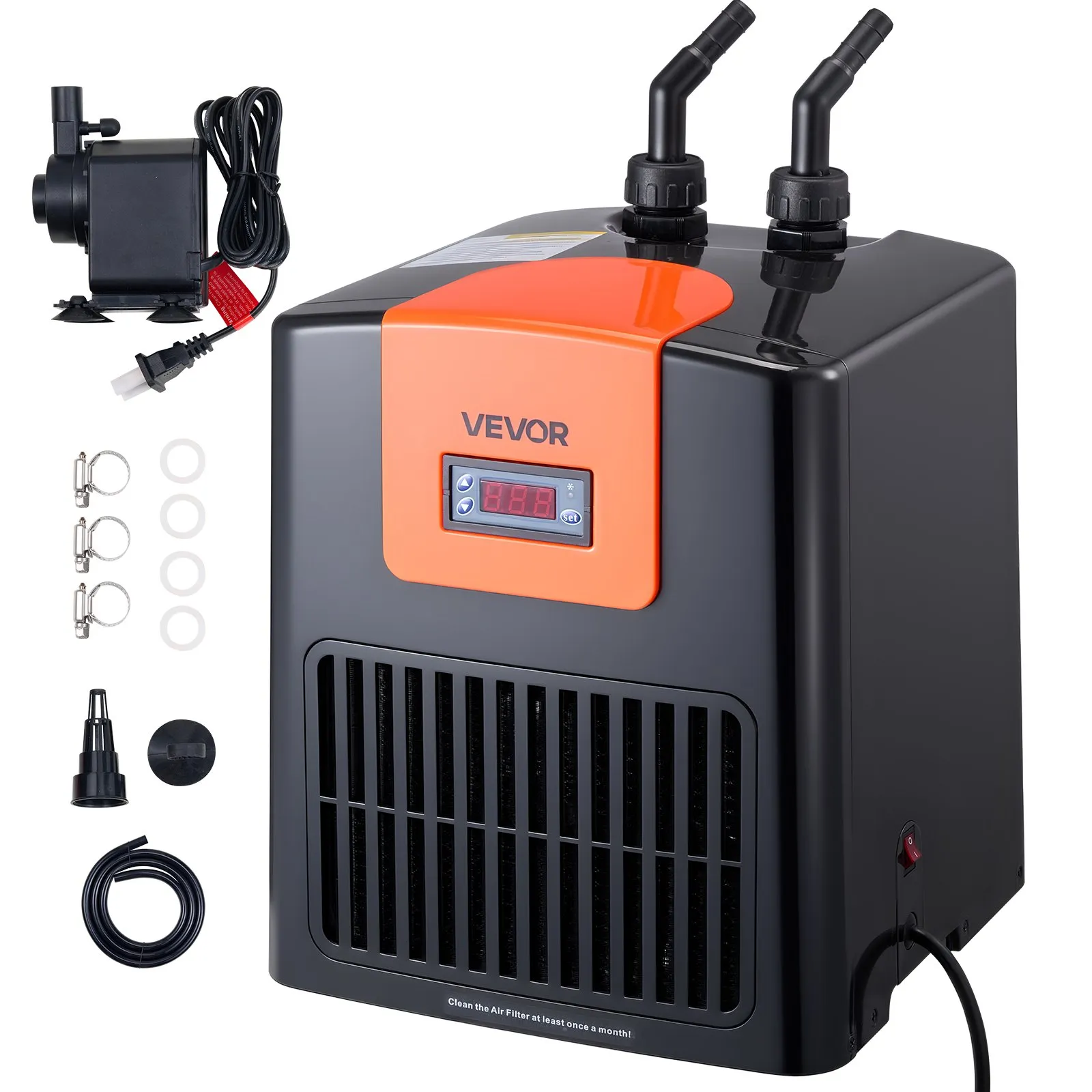
Compressor chiller; titanium evaporator; reaches 39°F. For tanks up to 40–52 gallons in moderate climates. Includes pump.
View on Vevor →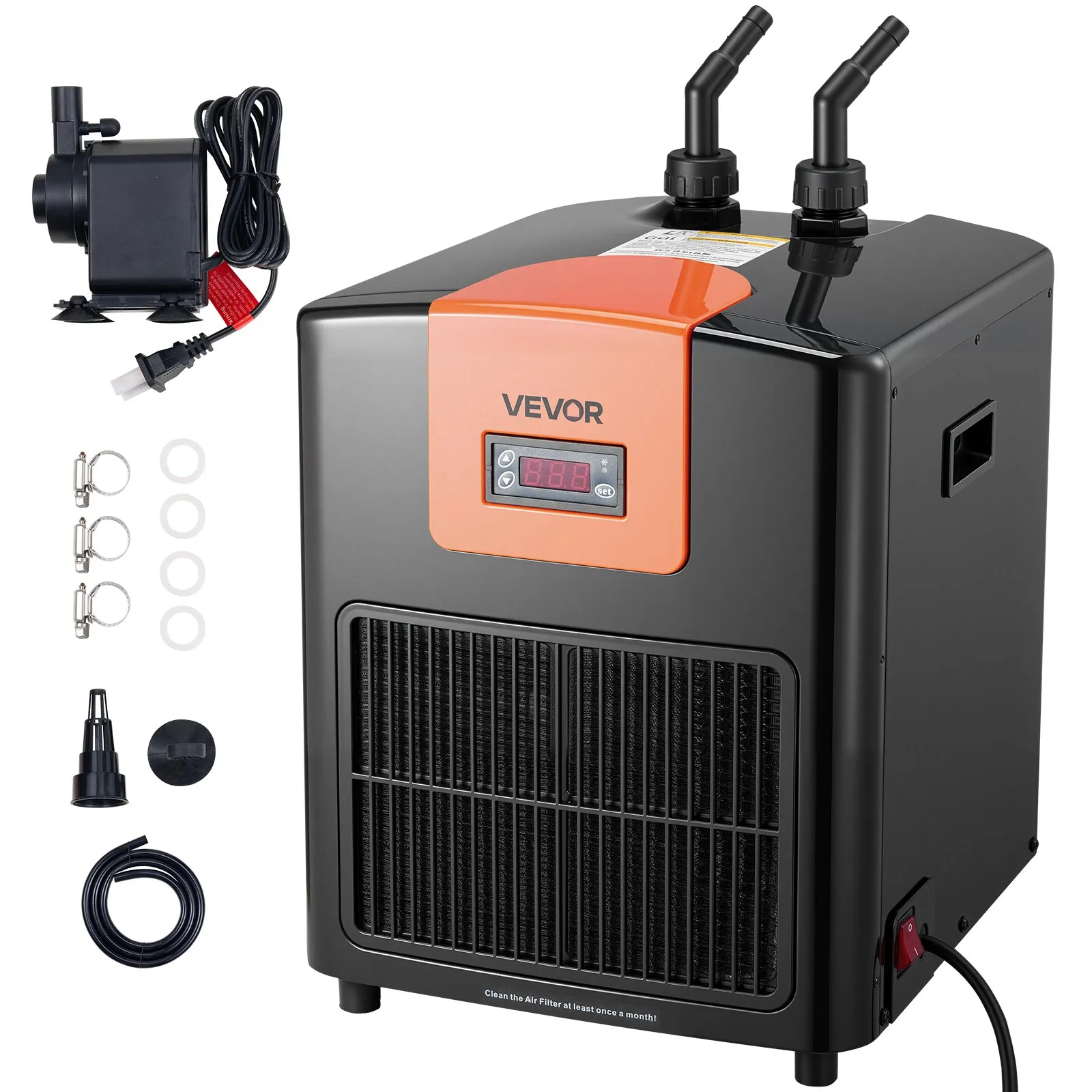
For larger tanks, warm climates, or setups where the 1/10 HP doesn’t have enough headroom. Includes pump. Confirmed on large setups. Full review: Vevor CL-850 review →
View on Vevor →For specific model recommendations and head-to-head comparisons, see our aquarium chiller for axolotl buyer’s guide.
Alternatives, honestly assessed
| Method | Verdict | Detail |
|---|---|---|
| Air-conditioning the room | Works well | Cooling the room lowers the tank’s baseline and can reduce or eliminate the chiller load. Often the cheapest fix if you already have AC. Best used alongside a chiller, not instead of one in warm climates. |
| Moving to a basement | Works | Basements run cooler and more stable year-round. Free if you have one. May be the simplest solution for some keepers. |
| Cooling fan across the surface | Works, with limits | Evaporative cooling can drop water several degrees. Effect weakens in humid conditions. Top off with dechlorinated water regularly to replace evaporation. |
| Lid off / open top | Helps | Improves evaporative cooling but increases evaporation and water loss. Note: a covered tank reduces evaporation, which makes a chiller’s job easier but a fan’s job harder. |
| Reducing lighting | Helps | Axolotls do not need bright light and generally dislike it. Less light means less heat. Switching to lower-wattage LED reduces both heat and stress. |
| Frozen water bottles | Emergency only | See the warning below. They work but produce temperature swings. |
| Ice cubes directly in the tank | No | Introduces untreated water and causes sharp temperature swings. Never. |
They cool in a sawtooth pattern: sharp drop when added, steady climb as they melt, sharp drop again on replacement. Axolotls are sensitive to temperature change, not just absolute temperature. Repeated swings can be stressful even when the daily average looks acceptable. Use them for a heat spike or while a chiller is being delivered. Never use them as a summer strategy. Never add ice directly to the tank.
Summer preparation should include confirming the chiller is operational AND keeping frozen bottles of dechlorinated water in the freezer as a backup. Chillers fail. Power goes out during storms. Bottles cost nothing and are the difference between a stressful afternoon and a dead animal. Source: ExoPetGuides axolotl temperature guide.
Installation and placement
A chiller removes heat from water by dumping it into the surrounding air. If that air is already hot or trapped, the condenser cannot release heat efficiently — the unit runs longer, cools less, or fails entirely. Placing the chiller in a sealed cabinet without ventilation is the most common installation mistake. It overheats and shuts down. A chiller in a small closed room also creates a feedback loop — it heats the room, which raises its own load.
| Requirement | Detail |
|---|---|
| Clearance | Follow the manufacturer’s spec. Most units need 10–12 inches on all sides, especially the exhaust. |
| Ventilation | If the chiller lives in a cabinet, that cabinet needs real airflow — vents, a cutout, or a small fan. |
| Not in direct sunlight | Frequent and frequently ignored. |
| Level surface | Compressor units must sit level. Tilting during use or storage can damage the compressor. |
| Monitoring | Always keep an independent thermometer in the tank. Controllers drift. Two sensors disagreeing is how you catch a failing controller early. For axolotls, a high-temperature alarm is worth the cost. |
⚠️ Heat spike emergency protocol
Heat stress compounds quickly. The following steps take priority.
Immediate actions
- Turn off all lights over the tank
- Remove the lid and place a fan blowing across the water surface
- Add sealed frozen bottles of dechlorinated water gradually — bring temperature down over hours, not minutes. A crash cooling is its own stressor.
- Turn on room air conditioning if available, or move the tank to the coolest room in the house
- Do a partial water change with cooler dechlorinated water, matched carefully — gradual, not shocking
- Increase surface agitation. Warm water holds less dissolved oxygen; aeration matters more as temperature rises.
- Do not feed while the animal is heat-stressed. Digestion adds metabolic load and uneaten food fouls the water.
- Once below 68°F, maintain it and monitor closely for the next 48–72 hours
Heat stress suppresses the immune system. Fungal or bacterial infections may appear 24–72 hours after a spike even if temperature has been corrected. Watch for: cotton-like growths on the gills, white patches on the skin, food refusal, lethargy, abnormal floating, curled or degraded gill filaments.
Saprolegnia — the white fuzzy growth seen on stressed axolotls — is the common culprit. Source: ExoPetGuides.
Many fish medications are NOT safe for amphibians at standard dosing. Axolotls have permeable skin and external gills — they absorb what is in the water in a way fish do not. Contact an exotic-animal veterinarian if the animal was exposed above 75°F for more than about four hours, or if any infection signs appear. Source: ExoPetGuides.
Common mistakes
| Mistake | Consequence |
|---|---|
| Sizing by “recommended tank size” on the box | Box ratings assume an ideal cool room and a small ΔT. Do the BTU math. |
| Ignoring sump or canister volume | A 40-gal tank with a canister is more than 40 gallons of water to cool. |
| Forgetting equipment heat | Pump and light watts become heat. Watts × 3.41 = BTU/hr added to the load. |
| Buying thermoelectric for a large ΔT | They handle small volumes and a few degrees. Not a 13-degree drop on 40 gallons. |
| Running below the chiller’s minimum flow | Poor heat exchange and risk of freezing inside the unit. |
| Blasting the axolotl with the chiller return | The animal cannot tolerate the flow the chiller needs. Diffuse the return. |
| Putting the chiller in a sealed cabinet | The most common installation failure. It overheats and shuts down. |
| Relying on frozen bottles as the summer plan | Temperature swings are their own stressor. Bottles are for emergencies only. |
| Trusting the chiller controller alone | Controllers drift. Keep an independent thermometer in the tank at all times. |
| Assuming the danger has passed once temperature is corrected | Infections may appear 24–72 hours later. Watch for 3 days. |
| Treating with fish medications | Many are not safe for amphibians at standard dosing. Call a vet. |
| Waiting until the first heat spike to plan | Keepers in warm climates should have a cooling plan in place before summer starts. |
Buying checklist
| # | Check | Why |
|---|---|---|
| 1 | Calculated BTU/hr with 15–20% margin | Tank size alone is not a specification. |
| 2 | Performance at YOUR ΔT, not the rated ΔT | A unit may deliver ~60% of rated output at low ΔT. |
| 3 | Total system volume including sump or canister | Not just display tank gallons. |
| 4 | Minimum and maximum GPH | Determines your pump choice and how you diffuse the return. |
| 5 | Compatible pump at actual head height | Box ratings are at zero head. Measure actual delivered flow. |
| 6 | Noise rating published | Under 50 dB for living spaces; under 40 dB for bedrooms. |
| 7 | Temperature stability tolerance | ≤±0.3°F or tighter. |
| 8 | Titanium heat exchanger | Standard on quality units. Corrosion-resistant. |
| 9 | Condensate handling | Self-evaporating or drain port for indoor use. |
| 10 | Ventilation plan for where it will sit | The most common installation failure is an enclosed, unventilated space. |
| 11 | Independent thermometer with alarm | Do not trust one sensor. A high-temp alarm is essential for axolotls. |
| 12 | Backup plan — frozen bottles, fan | For failures and power outages. Have them ready before summer. |
For a broader water chiller sizing calculator covering all use cases, see our water chiller sizing guide.
FAQs
What temperature does an axolotl need?
The ideal range cited across veterinary and husbandry references is 60–64°F (16–18°C). Sustained temperatures above 68°F begin suppressing the immune system. Above 72°F most animals show visible stress. Above 74–75°F the animal is in genuine danger and one reference reports fatal fungal infections developing within a week at 76°F. Source: VCA, PetMD, RarePetHub, SmallPetExpert.
What size chiller do I need for an axolotl tank?
Use the BTU formula: gallons × 8.3 × °F drop needed, then add 15–20%. For a 40-gallon tank needing to drop from 76°F to 63°F: 40 × 8.3 × 13 + 20% ≈ 5,000 BTU/hr. Do not use the tank volume alone — it ignores your actual temperature differential, your sump or canister volume, and the heat your pump and lights add. Include those in the calculation. See the sizing section above for the full worked example.
Why does my chiller freeze up inside?
Almost always caused by insufficient water flow through the heat exchanger. Every chiller has a minimum GPH requirement — running below it causes the refrigerant coil to overcool and ice forms inside the unit. Check your pump’s actual delivered flow (not the box rating) and confirm it meets the chiller’s minimum. For axolotl setups, use a dedicated chiller loop with a separate pump rather than relying on the main tank circulation pump, which may not deliver enough flow.
How do I use an aquarium chiller with an axolotl without stressing it with current?
This is the key axolotl-specific problem. Use a dedicated chiller loop: a separate small pump feeds the chiller and returns through a spray bar, wide diffuser, or outlet aimed at the glass. The chiller gets the flow it needs; the tank does not see a strong current. Never aim the chiller return directly at the animal or toward open water — diffuse it fully before it enters the tank.
Can I use a thermoelectric chiller for an axolotl?
Only for small tanks (under 15–20 gallons) where you need a small temperature drop (a few degrees). If your tank is larger, or if you need to drop temperature by more than 5–6 degrees, a thermoelectric unit will not keep up. For most axolotl keepers who actually need cooling — tank temperatures regularly hitting 70°F or above — a compressor chiller is required.
My axolotl is floating at the surface — is it sick?
Check the water temperature immediately. Abnormal floating, lethargy, and loss of appetite between 70–72°F are classic signs of heat stress — often mistaken for illness when temperature is the actual cause. Measure the tank water temperature (not the room) at its warmest point of the day. If it is above 68°F, address temperature first. If the animal is already above 74°F and showing gill changes (white cotton-like growth, degraded filaments), contact an exotic-animal veterinarian. Do not treat with fish medications.
How often do I need to run my aquarium chiller for an axolotl?
Continuously through the warm months, not only when you check the temperature. Chillers cycle on and off automatically via their thermostat — let them run. Turning a chiller off during the day to save electricity and back on in the evening allows the water to drift upward, creating temperature swings that stress axolotls. Run it continuously from spring through autumn in warm climates, and keep an independent thermometer with a high-temperature alarm so you know immediately if the chiller fails.