Best Water Chiller for Axolotls in 2026: Temperature Guide & Top Picks
In this guide
Axolotls are one of the most rewarding aquatic pets you can keep — but they are also one of the most temperature-sensitive. Get the water too warm and you face stress, fungal infections, and a shortened lifespan. Get it right and axolotls thrive, staying active, eating well, and living 10–15 years in captivity. A water chiller is the only reliable way to maintain axolotl-safe temperatures year-round, particularly in warmer climates or during summer months.
This guide covers exactly what temperature axolotls need, why alternatives fail long-term, how to size a chiller for your tank, and which units we recommend at each price point.
What temperature do axolotls need?
Axolotls are native to the ancient lake system of Xochimilco in central Mexico — a high-altitude environment that stays cool year-round. In captivity the ideal water temperature range is 60–68°F (16–20°C). This is the range in which axolotls feed consistently, regenerate tissue efficiently, and maintain a healthy immune system.
What happens outside this range
- Below 50°F (10°C): Axolotls become lethargic and stop eating. Sustained cold causes serious problems.
- 60–68°F (16–20°C): The ideal range. Active feeding, healthy regeneration, normal behaviour.
- 68–72°F (20–22°C): The stress zone. Short periods are tolerated but sustained exposure compromises immunity and increases disease risk significantly.
- Above 72°F (22°C): Dangerous. Heat stress causes buoyancy issues, fungal infections, gill deterioration, and eventually death. Most homes exceed this in summer without active cooling.
The uncomfortable reality for most axolotl keepers is that a typical US home sits at 70–75°F in summer — right in or above the danger zone without intervention. Fans, ice bottles, and cold water changes can buy time but none maintain a stable temperature consistently.
Why a chiller beats every alternative
Most axolotl keepers try the alternatives before committing to a chiller. Here is an honest assessment:
Ice bottles
Floating frozen bottles temporarily drop temperature but create wild swings — cold when fresh, warming rapidly as they melt, then a sharp rise again. Temperature swings are stressful for axolotls and can be more harmful than a consistently elevated temperature. They also require constant monitoring and replacement, making them impractical for anyone with a normal schedule.
Fans over the water surface
Evaporative cooling from a fan blowing across the water surface can drop temperature by 2–4°F in a dry environment. In humid conditions, barely 1–2°F. In a 75°F room that gets you to 71–73°F — still above the stress zone. Fans also evaporate water rapidly, requiring frequent top-offs and increasing the risk of mineral concentration and pH swings.
Air conditioning
Running home AC cold enough to keep a tank at 64°F means setting the thermostat to around 65–66°F — uncomfortable for humans and expensive to run continuously. It is also ineffective if the tank is in a room that does not cool uniformly.
A dedicated water chiller
A chiller maintains precise temperature 24/7 without intervention. Set it to 64°F and it holds 64°F whether it is 70°F or 90°F in your home. No swings, no monitoring, no daily ice runs. For serious axolotl keeping it is not optional — it is the only solution that works long-term. The upfront cost pays for itself quickly when you factor in veterinary treatment for sick axolotls or replacing animals lost to heat stress.
What size chiller for an axolotl tank?
Axolotl tanks typically run 20–75 gallons depending on how many animals you keep. A single adult axolotl needs a minimum of 20 gallons; two axolotls need at least 40 gallons. Most keepers run 40–75 gallon setups.
| Tank size | Axolotls | Recommended HP | Our pick | Price | Link |
|---|---|---|---|---|---|
| 20–40 gallons | 1–2 | 1/10 HP | Vevor 52 Gal, 1/10 HP | $283.90 | View → |
| 40–52 gallons | 2–3 | 1/10 HP | Vevor 52 Gal, 1/10 HP | $283.90 | View → |
| 52–110 gallons | 3–5 | 1/3 HP | Vevor 110 Gal, 1/3 HP | $389.90 | View → |
Important note: if your home gets above 80°F in summer, size up one tier. A chiller working in a hot room has less effective capacity than the same unit in a cool space. For more on this see our full water chiller sizing guide →
Top picks for axolotl tanks
For our full in-depth review of the 110-gallon model see: Vevor 110 Gallon CL-850 review →
1. Vevor Aquarium Chiller 52 Gallon, 1/10 HP — Best for most axolotl keepers
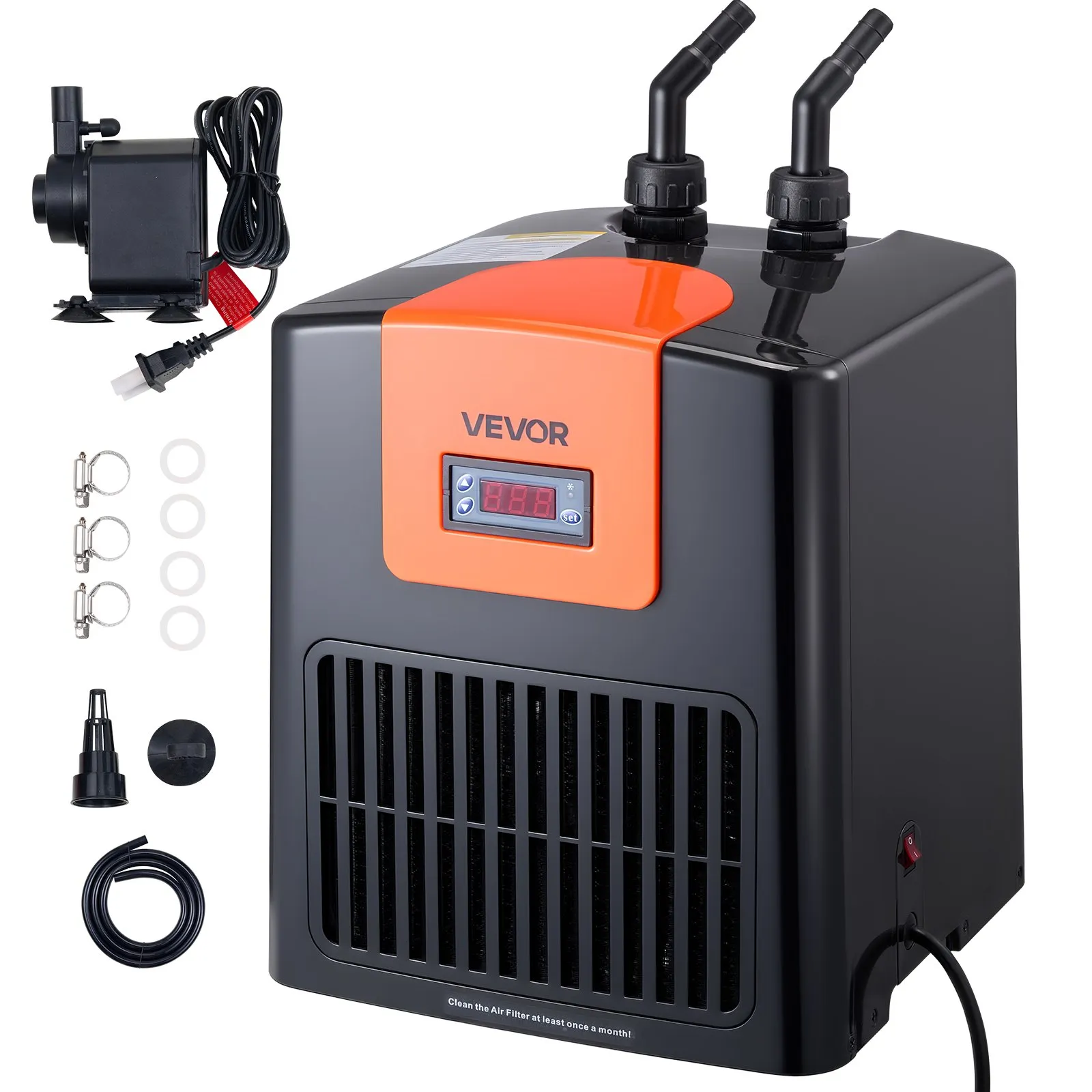
This is the unit we would recommend to most axolotl keepers running a standard 20–52 gallon setup. The compact black form factor fits easily next to or behind an aquarium stand. It ships with a submersible circulation pump, hose fittings, and clamps — everything needed for a complete setup without additional purchases.
The digital thermostat holds temperature within ±2°F, which is more than adequate for axolotl keeping. Set it to 63°F and it maintains a consistent 62–64°F range. The titanium evaporator resists corrosion from mineral buildup in aquarium water, and the rotary compressor runs quietly enough for a bedroom or living room setup.
Best for: Single or paired axolotls in 20–52 gallon tanks. Indoor setups in climate-controlled rooms. First-time chiller buyers.
Limitation: In rooms above 80°F in summer, cool-down times extend and the unit works harder. If your space gets hot, consider the 110-gallon model for more headroom.
2. Vevor Aquarium Chiller 110 Gallon, 1/3 HP — Best for warm climates or larger tanks
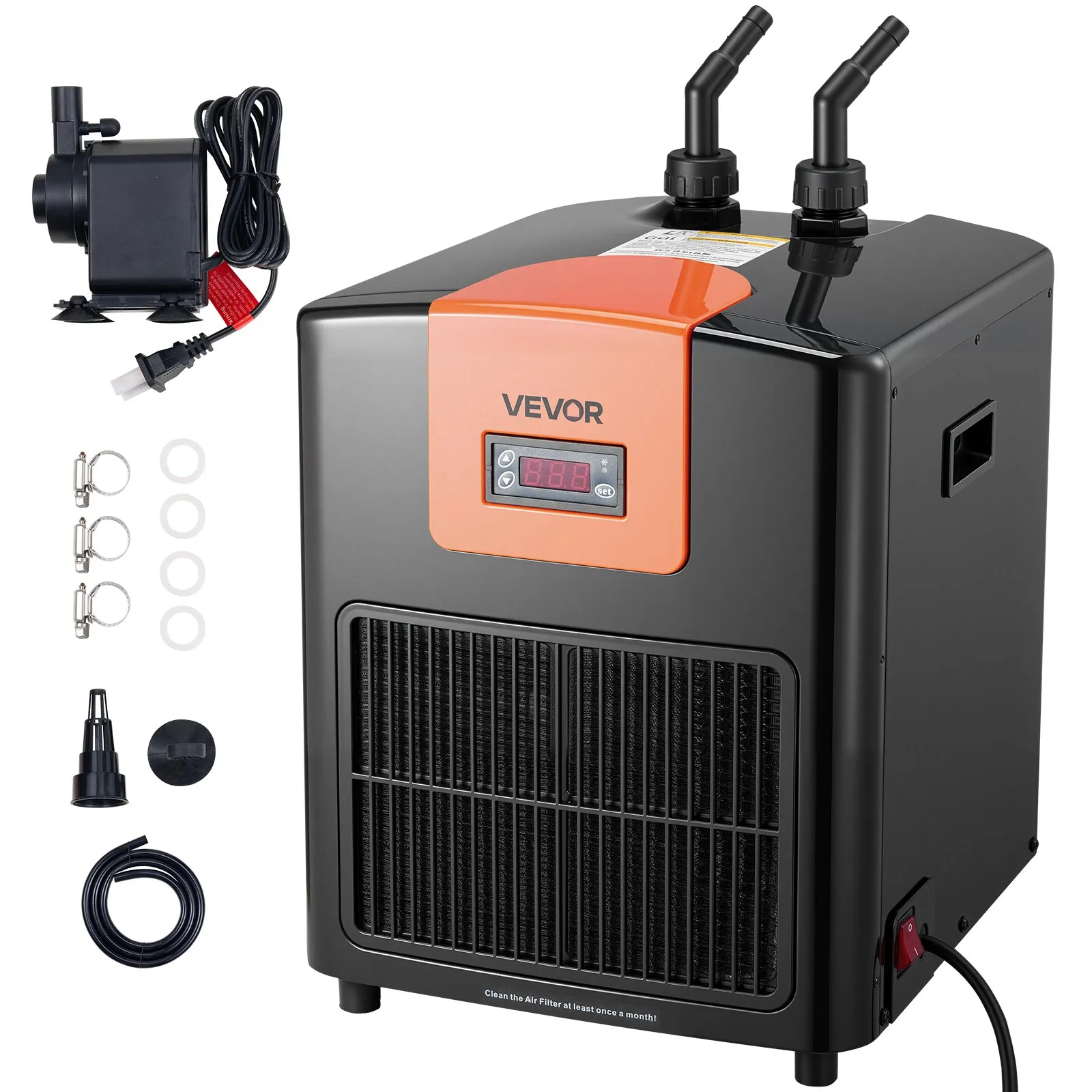
For axolotl keepers in warm climates, larger 55–110 gallon tanks, or anyone who wants maximum reliability without worrying about ambient temperature — the 110-gallon 1/3 HP model is the better long-term investment. At $106 more than the 52-gallon unit, it provides significantly more headroom and faster temperature recovery after water changes.
The additional HP means this unit holds 64°F reliably even when the room approaches 85°F in summer. It also recovers temperature faster after partial water changes — a practical benefit since axolotl tanks typically need 20–30% water changes weekly, which introduces warmer tap water the chiller needs to bring back down.
Best for: Warm climates, tanks 52–110 gallons, serious keepers who want set-and-forget reliability, rooms without air conditioning.
3. Used aquarium chiller via eBay — Budget option for larger setups
For keepers running larger multi-axolotl setups who need more capacity, the used market on eBay regularly turns up aquarium chillers from EcoPlus, Active Aqua, and similar brands at 40–60% below retail. Our eBay buying guide covers what to inspect before bidding.
Browse used chillers on eBay →
Setup tips specific to axolotl tanks
Place the temperature probe in the tank, not the return line
Always position the probe in the tank where the animals live, not in the output line where water has just been chilled. The probe controls what the chiller responds to — you want it reading actual tank temperature, not a cooler micro-environment near the return outlet.
Position the return outlet near the surface
Cold water is denser than warm water and sinks. Positioning the chiller return outlet near the top of the tank encourages circulation that distributes cold water through the full water column. Otherwise cold water may pool at the bottom while your axolotl swims in warmer surface water.
Never place the chiller in a sealed cabinet
Chillers exhaust warm air — in a sealed cabinet that warm air recirculates and reduces chilling efficiency significantly. Leave at least 12 inches of ventilation clearance around the unit, or position it outside the cabinet entirely.
Account for weekly water changes
Weekly partial water changes introduce warmer tap water into the tank. A 25% change on a 40-gallon tank adds 10 gallons at ambient tap temperature — enough to raise tank temperature by several degrees temporarily. Let the chiller bring it back down, or pre-cool replacement water in a separate container before adding it.
Set the thermostat to 63°F, not the minimum
Targeting 60°F means the chiller runs more frequently and the axolotl experiences more temperature cycling. Setting to 63–64°F keeps the axolotl comfortably in the middle of the safe range with less chiller cycling and a more stable environment overall.
Already own a Baoshishan chiller? See our Baoshishan troubleshooting guide. Considering Vevor? See the full Vevor review.
Need help sizing your chiller or solving the flow-rate problem? See our complete aquarium chiller sizing guide for axolotls — includes the BTU formula, the flow-rate conflict, and the heat emergency protocol.
FAQs
Do axolotls always need a chiller?
Not always — in cooler climates or well air-conditioned homes that stay consistently below 68°F year-round, a chiller may not be necessary. However most US homes exceed safe axolotl temperatures for at least part of the year. If your home reaches 72°F or above in summer, a chiller is the only reliable solution.
What is the ideal temperature for an axolotl tank?
60–68°F (16–20°C) is the accepted ideal range. Most experienced keepers target 63–65°F as the sweet spot — comfortably within the safe zone without pushing the chiller to its minimum.
Can I use a fan instead of a chiller for my axolotl tank?
Fans provide 2–4°F of cooling through evaporation in dry climates — usually insufficient to bring a warm-room tank into the 60–68°F safe zone. They work as a temporary measure but not as a permanent solution. They also cause rapid evaporation that requires constant top-offs.
What size tank does an axolotl need?
A single adult axolotl needs a minimum of 20 gallons. Two axolotls need at least 40 gallons. Most experienced keepers recommend 40–75 gallons for one or two axolotls — more water volume means more stable temperature and better water quality between changes.
How long does it take to chill an axolotl tank?
Starting from room temperature (72°F) with the Vevor 52-gallon unit on a 40-gallon tank, expect the tank to reach 64°F in approximately 2–3 hours in a 70°F room. The 110-gallon unit reaches the same temperature in around 1.5–2 hours. Once at temperature the chiller cycles on and off to maintain it with minimal effort.
Will a water chiller raise my electricity bill?
A 1/10 HP chiller draws approximately 100–150 watts when running. In most climates it cycles rather than running continuously — perhaps 30–50% of the time once the tank is at temperature. At average US electricity rates that works out to roughly $5–$12 per month depending on ambient conditions.
Is Vevor a good brand for aquarium chillers?
Vevor has become one of the most widely recommended aquarium chiller brands in the hobbyist community due to strong price-to-performance ratio and titanium evaporators that handle aquarium water chemistry well. See our full Vevor water chiller review →