CO2 Laser Chiller Guide 2026: CW-3000 vs CW-5000 vs CW-5200 — Which Do You Actually Need?
In this guide
- Quick picks
- Who this guide is for
- The one decision that matters: refrigeration vs thermolysis
- Which model for which laser wattage
- CW-5200 full specs (from the manual)
- Decoding the model suffix
- Controller settings: F0–F9 and the alarm interlock
- Genuine vs clone: how to tell
- Hot garage and humid climate guide
- Total cost of ownership (including tube replacement math)
- Common mistakes
- Maintenance schedule
- FAQs
Quick picks
| Pick | Model | Price | Why |
|---|---|---|---|
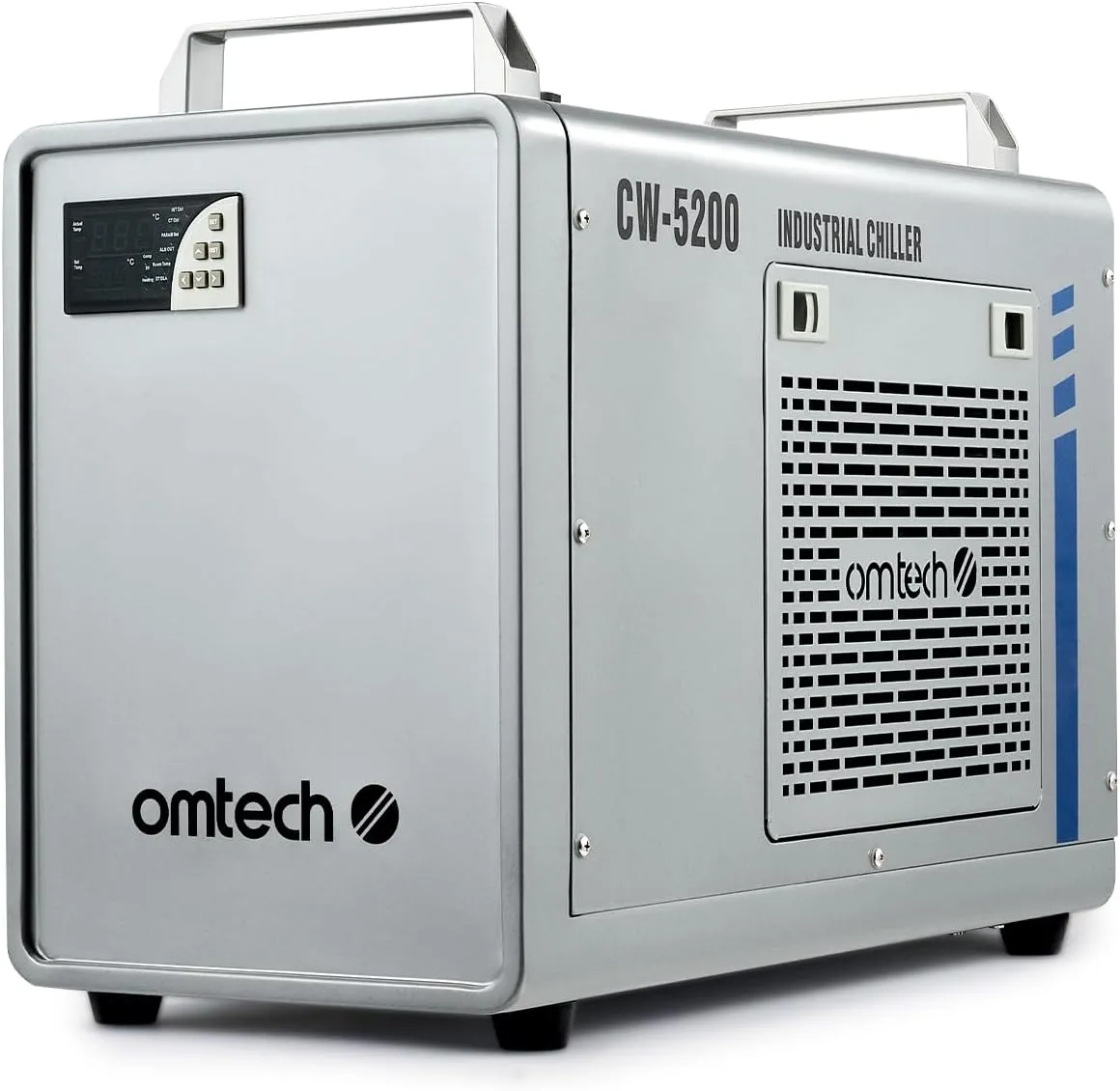
| 🏆 Best overall | OMTech CW-5200 (6 L, 110 V) | $437.39 with on-page coupon | 5,186 BTU/hr, ±0.3°C control, full alarm suite, ships from OMTech Direct with a real 30-day return path. Handles 60–150 W tubes with headroom in a hot shop. |
| 💰 Best budget | CW-3000 / CW-3000 PRO | ~$151 | Only defensible under 50 W in a climate-controlled room. It is a radiator and fan — not a chiller. Cannot cool below ambient temperature. |
| ⭐ Best premium | S&A TEYU CW-5200 (genuine) | $450–$496 | Factory serial verification, published service parts, manufacturer technical support. Same class as OMTech — worth the premium if serviceability matters. |
| 🌡️ Best for hot garage | CW-5200 in constant-temp mode | Same $437–$496 | The refrigeration circuit is the only thing that holds 25°C water when the room is 95°F. Passive units simply track ambient upward. |
| 🔁 Best for two lasers | CW-5202 (dual outlet) | $550–$900 | Two independent cooling loops. Do not split a single CW-5200 across two machines — this is what the CW-5202 exists to prevent. |
Under 50 W in an air-conditioned room, a CW-3000 is adequate. At 60 W and above — or anywhere with an unconditioned garage — buy a compressor chiller (CW-5200 class) and buy it at the same time as the laser, not after the first tube dies.
Who this guide is for
A laser chiller is the machine that protects the machine you actually want. Buyers routinely spend $4,000 on a laser cutter and try to save $200 on the component keeping its tube alive. This guide covers five buyer profiles:
| Profile | Typical setup | Environment | What drives the decision |
|---|---|---|---|
| K40 hobbyist | 40 W sealed glass tube, benchtop, a few hours a week | Spare bedroom or conditioned basement | Cost. The CW-3000 is defensible here and nowhere else. |
| Etsy side business | 60–80 W, evenings and weekends | Garage, uninsulated, unconditioned | Tube longevity. A dead tube on Thursday kills a weekend of orders. |
| Small production shop | 100–150 W, most of a working day | Shop bay or leased unit | Duty cycle and thermal headroom. Undersizing shows up as drifting cut quality. |
| The upgrader | Moving from 60 W to 130 W, or adding a second machine | Mixed | Size for next year, not today. A CW-5000 bought for a 60 W tube becomes a bottleneck the week a 130 W machine arrives. |
| Makerspace / classroom | Shared 80–100 W, untrained operators | Public-access room | Alarms and interlocks. The chiller has to protect the tube from people who will not check the water level. |
Not covered by this guide: diode laser owners (air-cooled by design, nothing to plumb), fiber laser owners (need CWFL series, not CW-series), RF metal-tube CO2 owners (requires CW-6000 class or manufacturer spec), and cold plunge buyers. CW-series laser chillers are not food-safe or certified for potable water contact — they are built and warranted for laser cooling only.
The one decision that matters: refrigeration vs thermolysis
This is the single distinction determining whether you are shopping in the $150 aisle or the $450 aisle, and it is deliberately obscured by product naming. Both types are sold as “industrial water chillers.” Only one of them chills.
| Thermolysis (CW-3000) | Refrigeration (CW-5000, CW-5200) | |
|---|---|---|
| What it is | Pump + reservoir + finned radiator + fan | Sealed compressor circuit with refrigerant, evaporator, condenser |
| How it works | Moves heat from water into the room | Drives water temperature below ambient and holds it there |
| Minimum water temperature | Room temperature — can never go below it | 25°C (77°F) held regardless of room temperature |
| 95°F garage in July | Water reaches 95°F or warmer — no cooling margin | Holds 25°C setpoint; higher compressor duty cycle |
| Power draw | ~50–60 W (pump + fan only) | ~700 W when compressor engaged |
| Noise | Fan noise only — quiet | Compressor + fans — noticeable |
| Price | $130–$180 | $330–$496 |
It is a fan and a copper coil rated to roughly 50 W of laser in a cool room. If your laser is 60 W or more — or your room gets hot — the CW-3000 is not a cheaper version of the right answer. It is the wrong answer at any price.
Which model for which laser wattage
| Tube rating | Heat to water (approx.) | Minimum sensible chiller | Comfortable choice |
|---|---|---|---|
| 40 W (K40) | ~400 W | CW-3000 in a cool, conditioned room only | CW-5000 |
| 60 W | ~600 W | CW-5000 | CW-5200 if unconditioned garage |
| 80 W | ~800 W | CW-5000, marginal in summer | CW-5200 |
| 100 W | ~1,000 W | CW-5000 at its ceiling | CW-5200 |
| 130 W | ~1,300 W | CW-5200 | CW-5200 |
| 150–180 W | ~1,500–1,800 W | CW-5200 at its ceiling | CW-6000 class |
| Two lasers up to 100 W each | ~2,000 W total | CW-5202 (dual loop) | CW-5202 or two separate units |
The practical rule: plan for roughly 10 watts of cooling capacity per watt of rated optical output, then add margin for your ambient temperature. The comfortable answer in the right-hand column is consistently one step above the minimum — because chiller capacity is measured under favorable conditions, and every real installation degrades it: a dusty filter, a warm room, a long hose run, or a tube that has drifted out of spec.
The CW-5000 vs CW-5200 gap at 100 W: the delta is about $77 with current coupons for nearly double the cooling capacity and a substantially larger pump. If you are anywhere near 80 W, or expect to upgrade within three years, the CW-5000 is the false economy here.
CW-5200 full specifications (from the OMTech manual)
These figures come directly from the OMTech CW-5200 Series User Manual, document LCW-5200-US, version V20240919, September 2024. Where retail listings differ from the manual, the manual is correct.
| Specification | CW-5200 D-series (110 V, 60 Hz) |
|---|---|
| Supply voltage | 110 V, 60 Hz |
| Current draw | 4.5–6.5 A |
| Compressor power | 0.68 kW (0.93 HP) |
| Refrigeration capacity | 5,186 BTU/hr · 1.52 kW · 1,307 kcal/hr |
| Refrigerant | R-407C / R-410A (factory sealed; not user-serviceable) |
| Refrigerant charge | 280 g |
| Temperature control precision | ±0.5°F (±0.3°C) |
| Tank capacity | 1.6 US gal (6 L) per manual — some listings claim 7 L or 9 L; these describe different products |
| Port fitting diameter | 10 mm or 8 mm — confirm before ordering hose; ask the seller directly |
| Net weight | 66.1 lb (30 kg) |
| Dimensions | 22 × 11.4 × 17 in (55.9 × 29 × 43.2 cm) |
| Rear clearance required | 12 in (30 cm) — not negotiable |
| Side clearance required | 4 in (10 cm) at both side air inlets |
| Alarm relay rating | Under 5 A, under 300 V (signal-level interlock, not a power contactor) |
| In the box | Chiller, power cord, alarm signal output plug, spare fuse, manual |
| Amazon ASIN (OMTech) | B0C8TQF6DN |
The manual specifies 0.68 kW compressor power = 0.93 HP. One current Amazon listing advertises 2.28 HP for a unit with the same manual behind it. A compressor did not triple in output because a listing said so. If the horsepower claim on a listing is more than double the manual figure, the listing is fabricated.
Decoding the CW-5200 model suffix
The two-letter suffix after CW-5200 is not a revision code. It encodes electrical supply (first letter) and pump size (second letter). Getting it wrong means a unit that will not run on your outlet, or one that cannot circulate through your machine.
| First letter | Supply voltage | Relevance to US buyers |
|---|---|---|
| A | 220 V, 50 Hz | European grid. Not a US residential fit. |
| B | 220 V, 60 Hz | Requires a 220 V circuit — viable in a shop, unusual in a garage. |
| D | 110 V, 60 Hz | The US residential variant. This is the letter you want. |
| Second letter | Pump power | Max flow | Max lift | Suited to |
|---|---|---|---|---|
| G | 30 W | 2.6 GPM | 32.8 ft | Short runs, single tube, bench-height machine |
| I ⭐ | 55 W | 4.2 GPM | 49.2 ft | Typical floor-standing cabinet, moderate hose run |
| K | 88 W | 5.3 GPM | 82 ft | Long runs, restrictive jackets, chiller located away from machine |
US buyers plumbing a typical floor-standing 80–130 W cabinet want: CW-5200DI or CW-5200DK. When the retail listing only says “CW-5200 110 V” without a suffix, ask the seller to photograph the rear label before purchasing. The OMTech Amazon listing (B0C8TQF6DN) ships the D-series variant — confirm pump suffix if it matters for your installation.
Controller settings: F0–F9 and the alarm interlock
The CW-5200 ships with a T-503 controller. Most owners never open the parameter menu. Two settings are worth understanding from the first day.
Intelligent mode vs constant-temperature mode (F3)
| Mode | F3 value | Behavior | When to use |
|---|---|---|---|
| Intelligent (default) | F3 = 1 | Water temperature tracks room at a set offset (F1, default −2°C), bounded 20–30°C | Humid environments where condensation on the tube is the main risk |
| Constant temperature | F3 = 0 | Holds a fixed setpoint (F0, default 25°C / 77°F) regardless of room conditions | Hot shops, production consistency, anywhere cut quality drifts as the day warms up |
The default intelligent mode is a humidity-safety decision, not a performance one. If your problem is a 100°F room rather than condensation, switch to constant mode: enter the parameter menu with passcode 08 and set F3 = 0.
Full parameter reference (F0–F9)
| Parameter | Meaning | Range | Factory default |
|---|---|---|---|
| F0 | Target water temperature (constant mode) | F9 to F8 | 25°C |
| F1 | Temperature difference from ambient (intelligent mode) | −15 to +5 | −2°C |
| F2 | Cooling hysteresis | 0.1–3.0 | 0.1°C |
| F3 | Control mode (0 = constant; 1 = intelligent) | 0–1 | Intelligent |
| F4 | Overheated water alarm threshold | 1–20 | 10 |
| F5 | Overchilled water alarm threshold | 1–20 | 15 |
| F6 | Overheated room alarm | 40–50 | 45 |
| F7 | Passcode | 00–99 | 08 |
| F8 | Highest allowed water temperature | F0 to 40 | 30°C |
| F9 | Lowest allowed water temperature | 1 to F0 | 20°C |
Alarm codes
| Code | Condition |
|---|---|
| E1 | Room temperature too high |
| E2 | Water temperature too high |
| E3 | Water temperature too low |
| E4 | Room temperature sensor failure |
| E5 | Water temperature sensor failure |
| Flow alarm (separate) | Insufficient water flow — blocked pathway, water shortage, or faulty pump |
The CW-5200 ships with an alarm signal output plug and a rear alarm terminal. Wired into your laser controller, it stops the laser automatically on a flow failure, water shortage, or pump fault — rather than beeping while the tube overheats in an empty room. The relay contacts are rated for under 5 A and under 300 V — this is a signal interlock, not a power contactor; do not switch mains through it. Wire it on installation day. It is in the box. Almost nobody does it. Do it.
Genuine vs clone: how to tell
The CW model numbers originated with TEYU S&A (Guangzhou Teyu Electromechanical, founded 2002). The designs proved popular enough that “CW-5200” now describes a form factor rather than a single product. S&A has published counterfeit identification guidance because the problem is that serious.
| Where to look | Genuine S&A TEYU | Clone or unbranded |
|---|---|---|
| Front and side sheet metal | S&A or TEYU logo present | Model number only, no maker logo |
| Temperature controller face | Branded controller | Generic controller, no branding |
| Rear product label | Serial number beginning CS, eight digits — verifiable with factory | Absent, non-conforming, or unverifiable |
| Normal operation indicator | Green | Yellow on known counterfeits — this is documented |
| Default passcode | 08 (as documented in manual) | Will not accept 08 — major red flag |
| Support path | Factory tech support; service parts listed | Marketplace messaging; often unanswered |
Independent laser integrator Lasers123: “Their chillers are so popular that the Chinese are starting to copy Chinese product.”
Where OMTech sits: OMTech entered the chiller market in late 2020. The T-503 controller, F0–F9 parameter block, default passcode of 08, and E1–E5 alarm codes are the S&A scheme exactly. S&A community troubleshooting and programming tutorials apply directly to an OMTech unit. The OMTech Amazon listing (B0C8TQF6DN) is sold and shipped by OMTech Direct with a 30-day refund or replacement window — the clearest return path in this category.
Hot garage and humid climate guide
A laser chiller does not make heat disappear. It relocates heat into the room it sits in, plus the energy the compressor consumed doing the relocating. A CW-5200 pulling ~700 W and removing 1,500 W from the water is putting over 2,000 W into your shop — comparable to a small space heater running continuously. In a closed garage in July, the room heats up, the condenser gets less effective, and the chiller works harder.
| Environment | Summer ambient | CW-3000 outcome | CW-5200 outcome |
|---|---|---|---|
| Conditioned interior room | 72–78°F | Workable under 50 W | Comfortable, low duty cycle |
| Insulated garage, no A/C | 85–95°F | Water tracks upward; tube runs hot | Holds setpoint; higher duty cycle |
| Uninsulated garage or carport | 95–110°F | Effectively no cooling margin | Holds setpoint; maintain clearance and filter |
The manual is explicit: if condensation forms on the chiller or water lines, raise the target temperature, warm the lines, or reduce ambient humidity until it stops. In a humid Gulf-influenced climate — or any unconditioned shop in summer — condensation forms on the coldest surface available. In a laser cutter, that surface is often the tube and its high-voltage end. Water plus twenty-odd kilovolts is a serious problem. Running at 25°C is not a target to beat. Running colder is not running better.
Total cost of ownership — with the tube replacement math
Five years, 20 hours/week of laser operation, electricity at $0.15/kWh, compressor duty cycle at 50%:
| Cost line | CW-3000 path | CW-5000 path | CW-5200 path |
|---|---|---|---|
| Purchase price | $151 | $360 | $437 (coupon) to $496 |
| Electricity, 5 years | ~$25 (pump + fan only) | ~$200 | ~$300 |
| Distilled water, 5 years | ~$80 | ~$80 | ~$80 |
| Algaecide, antifreeze, additives | ~$65 | ~$65 | ~$65 |
| Replacement hose, fittings, parts | ~$100 | ~$100 | ~$100 |
| 5-year hardware subtotal | ~$421–$536 | ~$805–$920 | ~$982–$1,156 |
At this point the table looks like an argument for the CW-3000. It is not, because one line is missing:
| Scenario | Tube cost | 5-year expected replacements | 5-year tube spend |
|---|---|---|---|
| 80 W tube, water held at 25°C | $250–$400 | 1 | $250–$400 |
| 80 W tube, water tracking a hot garage | $250–$400 | 2–3 | $500–$1,200 |
| 130 W tube, water held at 25°C | $450–$700 | 1 | $450–$700 |
| 130 W tube, chronically warm water | $450–$700 | 2–3 | $900–$2,100 |
One extra 80 W tube costs more than the entire price gap between a CW-3000 and a CW-5200. This is why experienced integrators advise buying the chiller at the same time as the laser, not after the first tube fails.
Common mistakes
| Mistake | What happens | The fix |
|---|---|---|
| Running the chiller before adding water | Pump runs dry — the manual leads its warnings with this | Fill with distilled water before the first power-on. Check the level again after the first run. |
| Outlet to outlet, inlet to inlet (reversed plumbing) | Tube partially unfilled while water appears to circulate; tube fires against partial water column and fails | The manual has one standalone Caution: chiller OUTLET to machine INLET. Trace both hoses end-to-end before first power-on. Label them. |
| Using tap water | Scale in tube jacket and chiller passages; raised conductivity | Distilled water only, changed quarterly |
| Not checking clearance | Recirculated hot air; high water temp alarms; reduced capacity | 12 in behind; 4 in at each side inlet. Not negotiable. |
| Chasing a low setpoint in a humid shop | Condensation on tube and high-voltage components | Raise the target temperature until condensation stops. 25°C is not a target to beat. |
| Leaving the alarm plug in the bag | Chiller beeps while tube overheats; nobody is in the room | Wire the alarm output into the laser controller on installation day |
| Buying on tank size | A 9 L tank on a passive unit still cannot cool below ambient | Buy on cooling type first, capacity second, tank size last |
| Panicking at the first-run flow alarm | Trapped air in lines triggers alarm that clears within minutes | Let it run. Re-check water level afterward. Top up as needed. |
| Splitting one chiller across two machines | Neither machine gets predictable flow; a fault in one propagates to the other | Buy a CW-5202 (dual circuit) or two separate units |
Maintenance schedule
| Interval | Task | Why |
|---|---|---|
| Every session | Check water level gauge in NORMAL band; confirm green flow light not red alarm | Running dry destroys pump and tube simultaneously. Flow failure with laser firing is the worst-case scenario. |
| Weekly (spring/summer) | Inspect side air filters for dust | A blocked filter is a documented cause of high water temperature alarms |
| Monthly | Check hoses and fittings for seepage | A slow leak shows as a steadily falling water level |
| Quarterly | Full coolant change with fresh distilled water | Prevents mineral scale and biological growth in narrow water jacket passages |
| Annually | Citric acid descale flush if anything other than distilled water was used | Dissolves limescale in narrow passages; inexpensive insurance |
| Before first freeze | Drain, or charge with distilled water + pink RV antifreeze blend | Freezing water cracks glass tubes and chiller internals |
| After winter | Flush antifreeze; refill with distilled water | Antifreeze is a seasonal measure, not a year-round coolant |
Use distilled or deionized water as the base coolant — low minerals, low conductivity. Tap water introduces chloride, calcium, and magnesium that scale narrow laser tube passages. Automotive antifreeze raises coolant conductivity and is not recommended. Pink RV antifreeze (propylene glycol) is the community standard for winterizing. Whatever additive you use, flush it out in spring. Antifreeze is not a year-round coolant.
FAQs
What is the difference between a CW-3000 and CW-5200?
The CW-3000 uses thermolysis (a radiator and fan) — it cannot cool water below room temperature. The CW-5200 uses a sealed compressor refrigeration circuit and holds water at a fixed setpoint (typically 25°C / 77°F) regardless of what the room temperature is. If your shop reaches 90°F in summer, a CW-3000 delivers 90+°F water; a CW-5200 still delivers 77°F water. For any laser above 50 W or any unconditioned workspace, the CW-3000 is the wrong tool.
What does the CW-5200 model suffix mean?
The first letter encodes voltage: D = 110 V, 60 Hz (US residential standard). The second letter encodes pump size: G = 30 W / 2.6 GPM / 32.8 ft lift; I = 55 W / 4.2 GPM / 49.2 ft lift; K = 88 W / 5.3 GPM / 82 ft lift. A US buyer running a typical floor-standing cabinet wants CW-5200DI or CW-5200DK. When the suffix is not listed, ask the seller to photograph the rear label before buying.
How do I switch the CW-5200 to constant temperature mode?
Enter the parameter menu with passcode 08. Navigate to F3 and set it to 0 (constant temperature). The default F0 setpoint of 25°C (77°F) is appropriate for most laser applications. Constant-temperature mode is recommended for hot shops where the room temperature exceeds your target water temperature — intelligent mode (the default) causes the water temperature to track the room, which defeats the purpose of the refrigeration circuit in hot weather.
What does the CW-5200 flow alarm E-code mean?
E1 = room temperature too high; E2 = water temperature too high; E3 = water temperature too low; E4 = room temperature sensor failure; E5 = water temperature sensor failure. There is also a separate flow alarm (not an E-code) indicating insufficient water flow — this is caused by blocked pathway, water shortage, or faulty pump. A first-run flow alarm with trapped air in the lines is normal and clears within a few minutes. If the alarm re-occurs after that, check the water level and inspect for blockages.
How do I know if a CW-5200 is genuine or a clone?
Four checks: (1) photograph the rear product label — a genuine S&A TEYU unit has a serial number beginning CS followed by eight digits; (2) enter the parameter menu with passcode 08 — a genuine unit accepts this; (3) confirm the normal operation indicator is green, not yellow (documented on counterfeits); (4) look for the TEYU or S&A logo on the front and side sheet metal, not just the model number. For OMTech units specifically, the ASIN B0C8TQF6DN sold directly by OMTech has a documented return path and uses the same controller and parameter scheme as S&A.
Should I use the CW-5200 in intelligent or constant temperature mode?
Constant temperature (F3 = 0) for hot shops — it holds 25°C regardless of ambient. Intelligent mode (F3 = 1, the default) for humid environments where condensation on the tube is the main risk — it keeps water near ambient temperature, reducing the temperature differential that causes condensation. In an unconditioned Southern summer shop, intelligent mode causes water temperature to drift upward with the room, which is exactly what you are trying to prevent. Use constant mode and manage condensation risk by not chasing a setpoint below 20–22°C.
Do I need to wire the alarm output on the CW-5200?
Yes — this is the most underutilized feature on the unit. The alarm signal output plug ships in the box. Wired into your laser controller, it stops the laser automatically when the chiller detects a flow failure, water shortage, or pump fault. Without it, the chiller beeps and the laser continues firing until the tube fails. The relay is rated for under 5 A and 300 V — it is a signal-level interlock. Wire it on installation day, test it by pinching the return line briefly to trigger the flow alarm, and confirm the laser stops. This is the most valuable 30 minutes of setup you will do.